Category Archives: Maternal

The Woman Who Believed a Home Was a Right: Helen L. Alfred (1889–1966)

Born June 24, 1889 — remembering my great-grandaunt on her birthday

If you had walked into a public hearing on slum clearance almost anywhere in America in the 1930s — Detroit, St. Louis, Boston, Memphis, New Orleans — there’s a good chance you’d have found a small, matronly woman in a felt hat at the front of the room, armed with statistics and an unshakable conviction that decent housing belonged to everyone. That was Helen Lillian Alfred: settlement worker, lobbyist, editor, and one of the quiet engineers of public housing in the United States.

She was the sister of my great-grandfather, Clarence J. Alfred, which makes her my great-grandaunt and a quietly remarkable person in our family tree.

From Lake Geneva to the Lower East Side

Helen was born on June 24, 1889, in Lake Geneva, Wisconsin, into a comfortable family. Her father, Almon S. Alfred, was a traveling salesman for the fine-paper firm George B. Hurd & Co.; her mother was Lucy Ives Alfred. Helen could have settled into a quiet, well-provided life. Instead she trained at the New York School of Social Work, served in canteen work for American troops in France during World War I, and then took charge of Madison House, a settlement house on New York’s crowded Lower East Side run by the Ethical Culture Society.

It was there, among the tenements, that she reached the conclusion that shaped the rest of her life: charity and social-service palliatives treated the symptoms, but the disease was housing itself. She went to Europe to study how cities there were already building decent homes for working people, came home, and threw herself into the problem. In 1932 she put her argument into print in a pamphlet titled Municipal Housing, published by the League for Industrial Democracy, a copy of which still survives in library collections today.

Building a movement
In 1931, the reformer Mary Kingsbury Simkhovitch founded the National Public Housing Conference (later renamed the National Housing Conference), the first independent national coalition of housing reformers. Helen was an early member and soon became its secretary and executive director, running the office at 122 East 23rd Street in Manhattan and editing the movement’s bulletin, Public Housing Progress.

This was the engine room of American housing reform. The organization helped persuade the Roosevelt administration to fold housing into early New Deal recovery programs, and it drafted the Wagner housing bill — the legislation that became the Wagner-Steagall Housing Act of 1937 and created the U.S. Housing Authority. Helen and her colleagues lobbied for it relentlessly. As she put it, the group “frankly says it is out with any possible weapon” to get the bill passed. Closer to home, the legislative groundwork she helped lay produced New York City’s very first public housing.

When the conference convened its first national gathering in Washington at the Willard Hotel in January 1934, drawing delegates from some thirty-five cities and nearly a hundred organizations, it was Helen who set the tone. She made the case for housing as a permanent public service rather than a passing emergency measure, but her sharpest point was about people, not policy: creating housing agencies and winning over public officials, she warned, was only half the battle, because “the determining factor in any worthwhile social movement is united action” within a community itself. Government willingness to act meant little, she argued, without an organized public to demand and sustain it — and she closed with a rallying cry for exactly that kind of grassroots organizing.

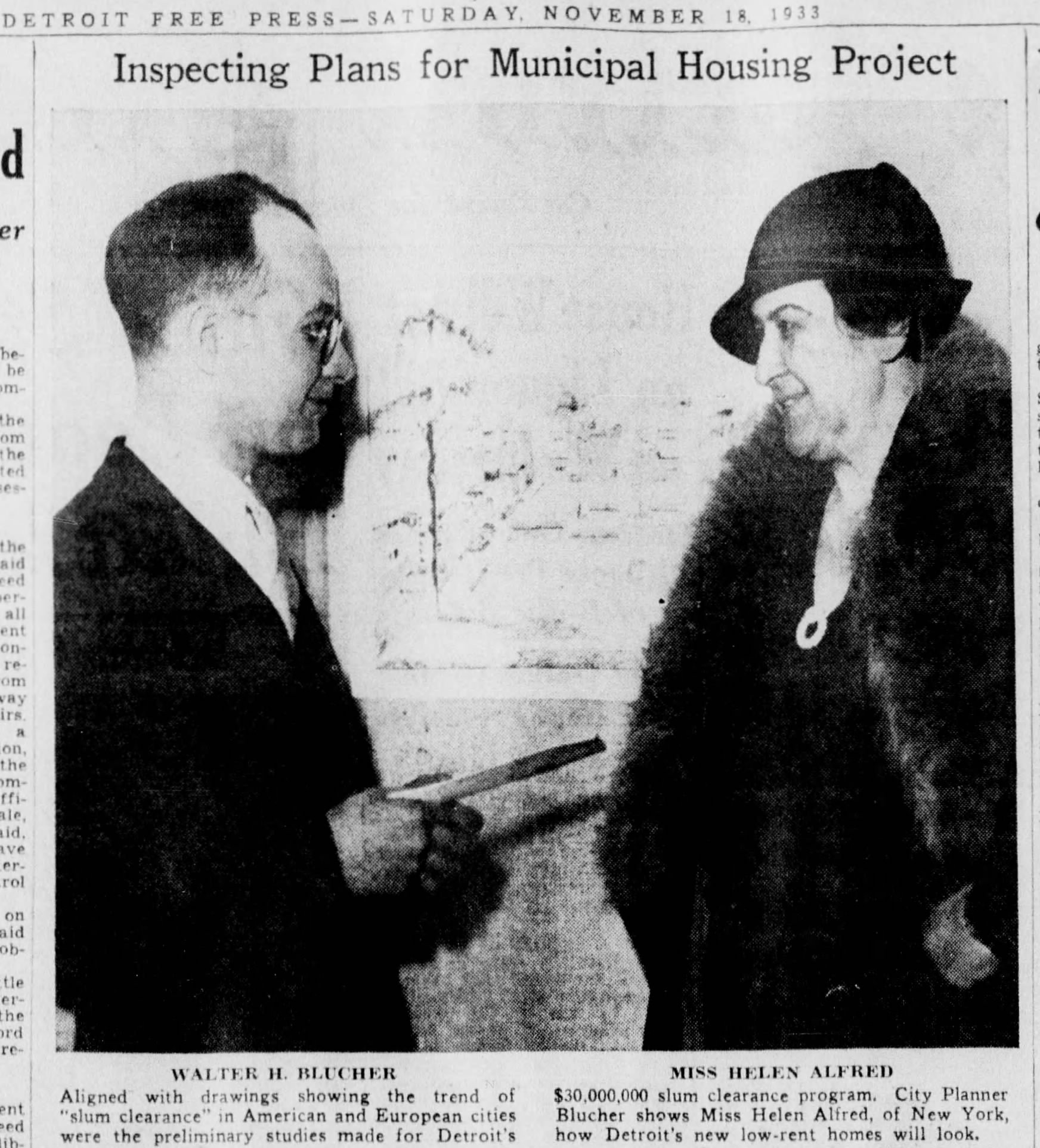
She was tireless on the road. She held conferences “in dozens of American cities” to stir up local support for slum clearance, touring through the South — Richmond, Charleston, Savannah, New Orleans, Birmingham, Nashville, Louisville — and across to the West Coast. In Detroit she championed the embattled Chandler Park project and was photographed studying the drawings for the city’s new low-rent homes. In Boston she declared the North End the worst slum she had ever seen, its crowding and filth “beyond description.” In St. Louis, Los Angeles, and Memphis she warned that America was decades behind Europe and pressed for permanent programs.

Her allies were formidable. Eleanor Roosevelt was among the earliest members of her organization. In her syndicated “My Day” column for April 13, 1936, the First Lady recorded cutting a horseback ride short to hurry home and see “Miss Helen Alfred who wanted to talk over some housing problems.” Senator Robert F. Wagner championed her cause in Congress, and the conference was received for tea at the White House. And Helen had a gift for the memorable line. People used to tell housing reformers to “go back to Moscow,” she liked to say — but by the late 1930s the movement they’d built had become, in her wry phrase, “almost disgustingly respectable.”

A matter of principle

Helen’s commitment to fairness didn’t stop at the front door. In the summer of 1951, at the height of the McCarthy-era Red Scare, a friend of hers — Simon W. Gerson, a New York Communist Party figure she had known since 1933, when he did publicity work for the housing movement — was jailed under the Smith Act. The bail fund that would normally have helped him had been shut out by the courts. So Helen, a former member of the Daughters of the American Revolution who was not herself a Communist, stepped forward and posted $10,000 of her own money to free him.

The reporters who came to her South Orange, New Jersey home couldn’t quite make sense of it. Her answer was simple: “Bail should be easily available, as stated in the Constitution.” When a prosecutor pressed her about her own politics, she shot back that asking whether she was a Communist for posting Gerson’s bail made about as much sense as asking a notorious gangster whether he used drugs. “My family came over from England 300 years ago to escape persecution,” she reminded a reporter — and the initials D.A.R., after all, stand for Daughters of the American Revolution.

It was, in its way, the same conviction that drove her housing work: that the protections and dignities a country promises on paper have to be made real for ordinary people, even (and especially) when it’s unpopular.

Later years

In her later decades Helen’s politics moved well to the left toward the very ideas her opponents had once flung at the housing movement as an insult. She edited essay collections titled Toward a Socialist America (1958) and Public Ownership in the U.S.A. (1961), was for a time a part-owner of the Communist Daily Worker, and lent her name as a sponsor of the American Institute for Marxist Studies; by the end, her causes ranged across civil rights, world peace, and Marxism. She remained active, too, in the League of Women Voters and was a member of the Unitarian church in Santa Barbara, California, where she spent her final years. She died there on February 23, 1966, at the age of 76, after suffering a stroke. A memorial service was held that spring back home in Lake Geneva, Wisconsin, where her story had begun.


My commentary

It’s easy for a name on a family tree to stay just a name. But Helen Alfred spent her life on a question we are still arguing about today: whether a safe, affordable home is a privilege to be earned or a right to be guaranteed. She didn’t only believe the latter — she organized, lobbied, traveled, wrote, and, when it counted, put her own money and reputation on the line for it.

I didn’t fully appreciate the echo until I looked back at my own career. For four years I worked in the Massachusetts Governor’s Office under Charlie Baker, and for three more in what was then the Executive Office of Housing and Economic Development. The work that filled those years turned out to be Helen’s work, carried forward a few generations. I was proud to help advance Governor Baker’s housing agenda: the largest housing bond bill in Massachusetts history at the time, the “Housing Choice” reforms that finally let cities and towns approve new housing by a simple-majority vote instead of a supermajority, and the MBTA Communities law, which presses communities to zone for the multifamily housing our state so badly needs. And when COVID-19 hit and people’s jobs and paychecks vanished overnight, I was there as we worked to keep families in their homes.

Helen spent the 1930s insisting that decent housing was a national responsibility and that government had to help lead the way; I spent the 2010s and 2020s working on the zoning, the financing, and the emergency aid meant to make some of that real. Her 1934 warning that standing up housing agencies and winning over officials was only half the battle, and that the decisive half was whether a community would unite and act landed on me with ninety years of hindsight. The MBTA Communities law proved her point exactly. Passing it on Beacon Hill was the easy part; the hard, human half has played out since in town meetings and zoning fights across the state, community by community. Whether the housing actually gets built is still being decided. Same fight, same conviction, just a different desk, the better part of a century on. I’d like to think she’d have approved.

Happy birthday, Aunt Helen. The fight you gave your life to isn’t finished, but it’s a good deal further along because of people like you.


Sources

Helen’s own words and writings

  • Helen Alfred, Municipal Housing (League for Industrial Democracy, 1932). Preserved in the HathiTrust Digital Library.
  • Helen Alfred, address to the first Washington Conference on Public Housing, Willard Hotel, Washington, D.C., January 27, 1934. Text published by the National Housing Conference (2022).
  • Helen Alfred, ed., Toward a Socialist America (1958), Public Ownership in the U.S.A. (1961), and World Trade for Peace (1964).

Contemporary accounts

  • Eleanor Roosevelt, “My Day,” April 13, 1936, The Eleanor Roosevelt Papers Project, George Washington University.
  • Newspaper coverage, 1933–1966, including the Detroit Free Press, The Worker, the Daily Worker, the Newark Star-Ledger, and the Santa Barbara News-Press (obituary, March 2, 1966), among others.

Histories and archives

  • “National Housing Conference,” organizational history (nhc.org) and Wikipedia.
  • “National Housing Conference, Inc.,” Social Welfare History Project, Virginia Commonwealth University (which lists Helen as an early member).
  • Simon W. and Sophie Gerson Papers, Tamiment Library, New York University (containing Helen Alfred correspondence), for the 1951 Smith Act bail episode.

A note on quotations: short quotes here are drawn from the sources above; the full 1934 speech can be read at the National Housing Conference’s site. Transcriptions of century-old clippings and addresses occasionally carry small OCR errors, which I’ve corrected silently where the intended wording was clear.
Forty-Eight Hours: My Great-Grandfather and the Palmer Raids

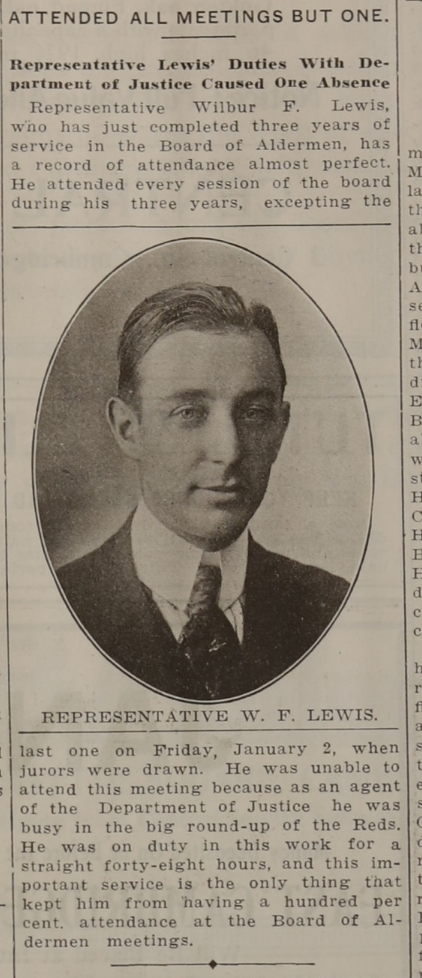
Among the clippings that I found recently through my research is a yellowed front page from the Somerville Journal, dated Friday, January 9, 1920. The headline reads “ATTENDED ALL MEETINGS BUT ONE,” and a portrait of my great-grandfather, Representative Wilbur F. Lewis, looking every inch the dutiful public servant.

After three years on Somerville’s Board of Aldermen, Wilbur had a nearly perfect attendance record. He had been present at every single session of the board across those three years with a single exception. And the reason for that one absence is what stopped me cold.

He missed the meeting of Friday, January 2, 1920, the paper explains, because “as an agent of the Department of Justice he was busy in the big round-up of the Reds.” He had been on duty in that work, it says, for “a straight forty-eight hours.” The Journal offers this as a point of pride — the one and only blemish on his attendance record, and a patriotic one at that.

It only took a quick Claude search to understand just how large the event behind that one casual sentence really was.

What “the big round-up of the Reds” actually was

My great-grandfather wasn’t moonlighting at some minor local affair. The date and the phrase “round-up of the Reds” point to one specific, infamous chapter of American history: the Palmer Raids.

To understand them, you have to feel the temperature of the country in those months. The First World War had just ended. The 1917 Russian Revolution had put a Bolshevik government in power and sent a tremor of fear through the Western world that revolution might be contagious. At home, 1919 had been a year of upheaval — major labor strikes (including the Boston Police Strike that fall, right next door to Somerville), race riots across the country in what became known as the “Red Summer,” and a wave of anarchist bombings, one of which damaged the home of the U.S. Attorney General himself, A. Mitchell Palmer.

Library of congress

Palmer, with the help of a young and ambitious Justice Department official named J. Edgar Hoover, organized a sweeping campaign to arrest suspected radicals, anarchists, communists, and especially foreign-born immigrants who could be deported without the bother of a full trial. The agency carrying out the work was the Bureau of Investigation, the direct ancestor of the FBI, which wouldn’t take that name until 1935. So when the newspaper calls Wilbur “an agent of the Department of Justice,” it is describing what we would now simply call an FBI agent.

The single largest sweep came on the very night Wilbur missed his aldermen’s meeting. On January 2, 1920, federal agents conducted coordinated raids in some thirty-three cities across more than twenty states, arresting thousands of people — estimates for that one day run from around three thousand to as high as six thousand — at meeting halls, social clubs, and private homes. Agents broke down doors and pulled people from their beds. The number of arrests vastly outran the number of warrants that had actually been issued.

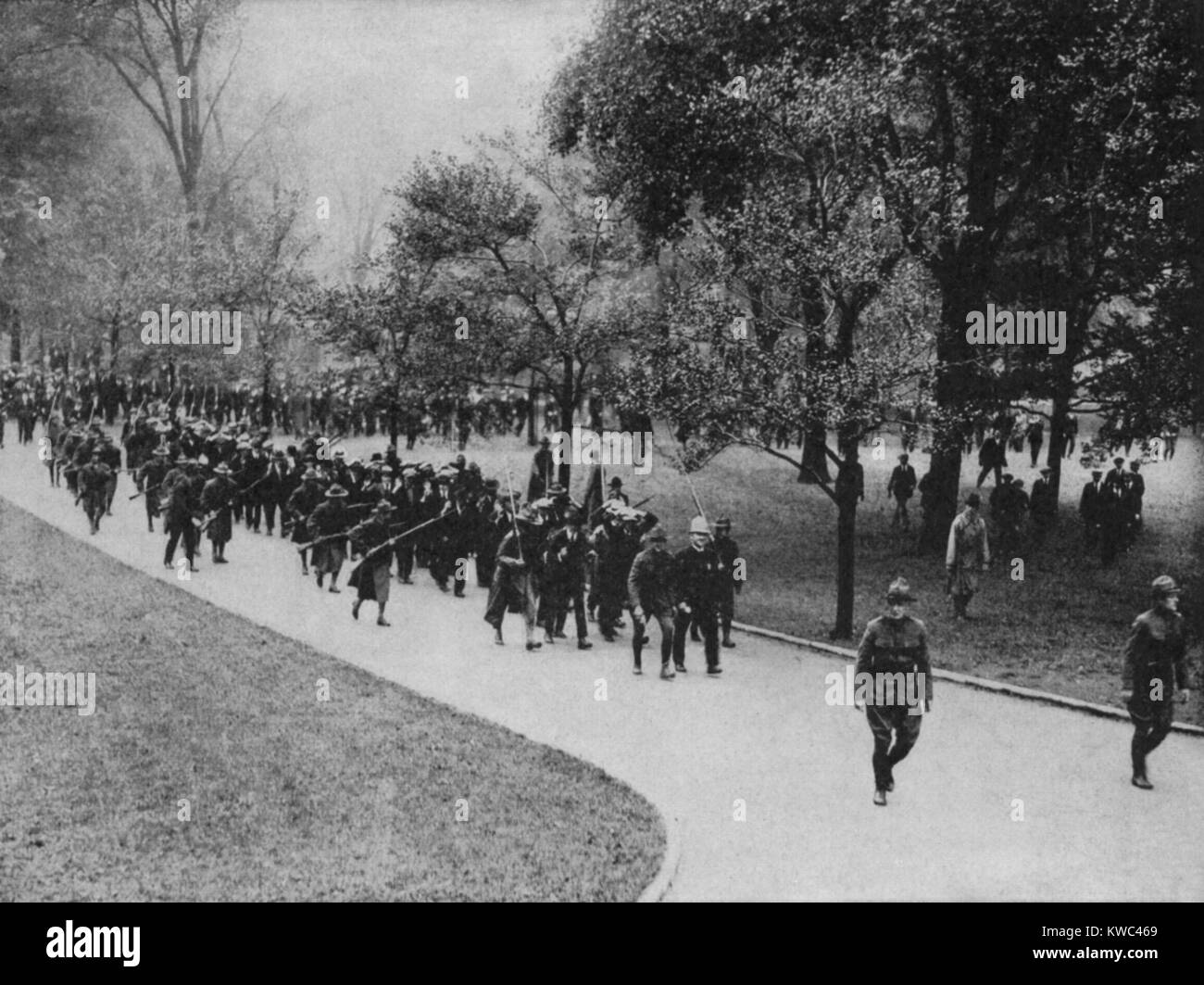
And here is the detail that brings it home for a Massachusetts family: the Boston area was one of the storm centers of the whole operation. Of the thousands arrested nationwide, over eight hundred were from the greater Boston area. A later federal court record describes the New England sweep as between roughly eight hundred and twelve hundred people arrested across the region, several hundred of them afterward locked up on Deer Island, out in Boston Harbor.

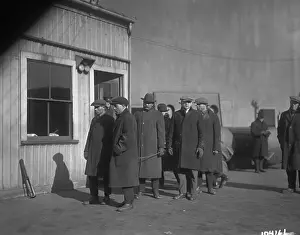
Boston police strike Black and White Stock Photos & Images ...
Police in Boston, Massachusetts, escort arrested leftists to confinement on Deer Island. (Everett Collection Historical/Alamy Stock Photo)

That is the work my great-grandfather was doing for forty-eight unbroken hours. As a Somerville-based Bureau agent, he would have been in the thick of the New England portion of the raids making arrests and processing detainees. These were simultaneous, overnight, all-hands operations, and the logistics of moving hundreds of arrested people were genuinely chaotic.

In January 1920, in the pages of the Somerville Journal, this was a badge of honor. The round-up was popular. It read as the young Bureau of Investigation taking decisive action against a frightening threat, and Wilbur’s part in it was something to celebrate.

How history changed its verdict

The cheering did not last.

Massachusetts prisoners seized during government raids awaiting transport to Deer Island on January 4, 1920.

Within months, the raids went from triumph to scandal, and it isn’t hard to see why. Most of the people swept up on January 2 had been seized without warrants. They were held in overcrowded facilities, frequently denied lawyers, denied contact with their families, and held for long stretches without being charged with any crime. Many turned out to have no meaningful connection to any radical organization at all — they had simply been in the wrong meeting hall, or the wrong social club, on the wrong night.

New England, where my great-grandfather worked, became the setting for one of the most important legal rebukes. In the Boston case Colyer v. Skeffington, federal judge George W. Anderson ordered detainees released and condemned the government’s conduct in scorching terms, writing that “a mob is a mob, whether made up of Government officials acting under instructions from the Department of Justice, or of criminals, loafers, and the vicious classes.” Among the lawyers who stepped in to argue against the deportations in that Boston courtroom were Harvard’s Zechariah Chafee and Felix Frankfurter — the latter a future justice of the United States Supreme Court.

The broader fallout reshaped American life. The outrage over the raids helped give birth to the American Civil Liberties Union. Officials within the government itself — notably Assistant Secretary of Labor Louis Post, who actually held the authority over deportations — reviewed the cases, found the evidence of dangerous subversion thin, and canceled the great majority of Palmer’s deportation orders. Of the thousands arrested, only a few hundred were ultimately deported. Even the FBI’s own published history today describes the raids as a low point, “a nightmare” of poor planning and trampled constitutional rights.

By the standards and convictions of his moment, my great-grandfather was doing his patriotic duty, and his neighbors honored him for it. That same duty also placed him inside one of the clearest civil-liberties failures in American history — a mass round-up, largely of immigrants, conducted without proper warrants and with little regard for due process.


A note from the present

The two sections above are family history and settled history. What follows is my present-day reflection.

I cannot write about my great-grandfather’s forty-eight hours without thinking about today’s headlines. The pattern that made the Palmer Raids infamous is depressingly ordinary. Take a moment of fear, point it at immigrants and dissenters, and let the federal government move faster than the Constitution can keep up. Warrantless arrests. People pulled from homes and meeting halls. Detention without charges, without lawyers, in overcrowded places. And, underneath it all, an attorney general and a Justice Department willing to treat the machinery of law enforcement as a political instrument.

We are watching it happen again.

The numbers alone are staggering. By early 2026, the number of people held in immigration detention reached the highest level ever recorded and reporting indicates the large majority of them have no criminal record at all, despite the official insistence that the targets are violent criminals. People have died in custody. Whistleblowers exposed an internal directive telling agents they could enter homes to make arrests without a judicial warrant — a directive that constitutional scholars and at least one federal judge say violates the Fourth Amendment, the very protection against unreasonable search and seizure that Colyer v. Skeffington was fought over a century ago. The administration tore up the longstanding policy that had kept enforcement away from schools, churches, and hospitals. Agents have staked out courthouses. In Minneapolis in January 2026, federal agents shot and killed two U.S. citizens.

The lesson of the Palmer Raids isn’t that the agents were monsters. My great-grandfather wasn’t a monster; he was a man doing what his government told him was right and necessary, in a climate engineered to make resistance feel unpatriotic. The damage was done not by villains but by ordinary public servants who let fear and authority do their thinking for them, and by leaders who were happy to supply both. The country needed the judges, the lawyers, the Louis Posts, and the ordinary citizens who said no — who insisted that a mob is a mob even when it wears a badge and carries federal orders.

Some of that pushback has already started, this time mostly from the courts — and, as it happens, from the same Massachusetts federal court that delivered Judge Anderson’s rebuke a century ago. Where it took an official like Louis Post to cancel the bulk of Palmer’s deportation orders, in February 2026 a federal judge in Massachusetts struck down the administration’s policy of deporting immigrants to third countries with no notice and no chance to object, ruling that it violated their right to due process. Within weeks an appeals court put that decision on hold while it weighs the government’s appeal, and the case looks likely to end up at the Supreme Court.

I oppose what is being done in my country’s name today. I oppose the round-ups, the warrantless raids, and the detention of people whose only offense is who they are and where they were born.

My great-grandfather’s generation eventually decided that the Palmer Raids were a stain. They didn’t reach that judgment in the heat of January 1920, when the parades were marching and the newspapers were proud. They reached it afterward, in the courts and the conscience of the country. I don’t want to wait for afterward this time.


Sources and further reading

On the Palmer Raids:

On the present-day parallels:

Dr. John Ives oration during Decoration Day (Memorial Day) in 1872

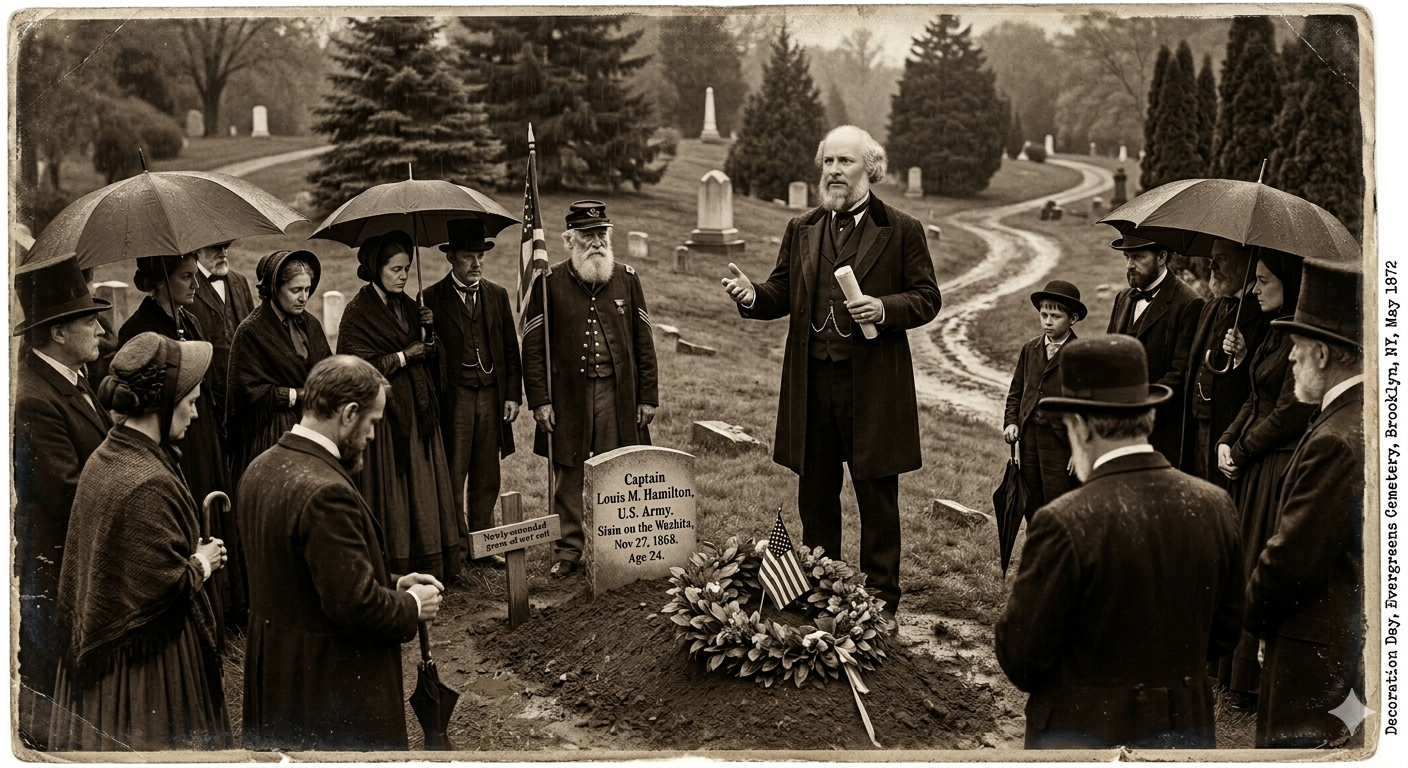
Google Nano Banana image of what the ceremony may have looked like in 1872.

A Decoration Day (what we call Memorial Day today) ceremony was held at the Evergreens Cemetery in Brooklyn, New York, in May 1872, and written about in the Brooklyn Daily Times on May 30, 1872. The ceremonies, which were attended by scores of people, took place at the grave of Captain Louis M. Hamilton, “who distinguished himself in the war of the Rebellion, and was afterward slain while fighting the Indians on the Washita.” At the time of his death, he was only twenty-four years of age. Both his mother and father (Judge Phillip Hamilton, was the son of Alexander Hamilton, a founding father of the United States and member of President George Washington’s cabinet) were in attendance.

After a procession through the area streets, Dr. John Ives, my 3x great-grandfather and a resident of East New York, delivered an oration at the gravesite. He was 59 years of age at the time. Here is that oration:

Fellow Citizens and Members of the Grand Army of the Republic: In common with those whose sympathies are enlisted in behalf of the defenders of our beloved country, we are here to accommodate a sense of duty, to assist in paying a small tribute of respect not only to the dead patriots, but to the living ones. To the living we can be of real and pecuniary service. We can minister to their necessities, for it happens that many of them are poor in purse though rich in devotion to country. Very many of them sacrificed all but life, in defence of liberty, and the equality of all men before the law. Let us, then, pay a passing tribute to their worth, to their heroism, to their devotion to principle, while we garnish the graves of the dead hero. Well I remember how, with banners flying, with high hopes and zeal to punish the audacious insolence of the rebel clan, you bid adieu to your loved at home to defend your insulted flag; and well you did it; and a grateful country’s benediction rests upon you. We rejoice to-day that we have a country, that we have a flag—through your interposition. We rejoice in the fact that you live to enjoy the fruits of your labor; that through your toils, through your privations, soldiers and civilians alike can claim one undivided country and one honored flag.

Yet, while we rejoice, we are saddened by the thought that so many of your brave comrades perished upon the field of battle—and this assemblage, this impromptu gathering of the people, of sire and son, of matron and maid, and veteran soldiers around the resting places of our heroic dead, to drop the tear of sympathy, and to strew garlands and evergreens upon their graves, shows that love and gratitude for noble deeds springs perennial within the human breast, that acts of valor and devotion to country can never be forgotten. It demonstrates still another fact, that man is capable of unselfish and ingenuous impulses.

The dead hero returns no awards, he is uninfluenced by threat or moved by flattery, the gentle zephyr and fierce hurricane are alike to him; they pass unheeded by. He sleeps the sleep that knows no waking till the archangel’s trump shall bid him awake to life again.

This ingenuousness referred to is to the nation another bow of promise, set in our political firmament in token that neither the oppressor nor the enslaver, nor the rebel chieftain, nor any other combination of designing men, can assail our country’s flag and go unharmed. Those who know the way will lead, and thousands will follow them to victory as in the past.

The thought which culminates in setting apart this day in commemoration of the bravery, the toils, the sacrifices, and sufferings of our noble dead was grand and patriotic. While we look upon these silent monuments, while we view the green sod overlying the crumbling remains of sleeping heroes, our minds revert to the days of strife, of carnage, and of dire war; when the whole earth seemed to tremble beneath the majestic tread of contending millions. It was then the hearts of the timid quailed for very fear, and their knees knocked together as if beating the tattoo of departing loyalty. It was said by one highest in authority in the land, that there was no power in the government to coerce the seceding states. Another preached the strange doctrine to the people that the rebel states had a right to secede, if a majority desired it, and in a paroxysm of chivalrous intent cried out “let the wayward sisters go.” The one was repudiated by the people, the other is only awaiting his turn. But you, veteran soldiers, maimed and scarred in your country’s cause with the dead heroes around me, you bared your breasts to the insolent foe, you feared not their menace, but said defiantly—shoot through us at our country—over our prostrate and bleeding corpses you shall creep before you can devastate our homes, our firesides — that flag we defend was never made to be trailed in the dust by rebel hands. The scenes enacted at Corinth, Donaldson, Vicksburg, “The battle above the clouds,” Gettysburg, the march from the mountains to the sea, the struggle through the Wilderness, the final triumph, all pass swiftly in review before us to-day, and while we rejoice that peace has been restored, we can but mourn the loss of our comrades dead. We have not only a duty to perform to the living and the dead heroes of the war, we have a duty to perform towards the orphans left a legacy to the nation. They, too, must be cared for. I bespeak for them the fostering care of the philanthropic and the good. Have them cherish a love of country; let them be taught to reverence the flag their fathers died to protect.

Sir, there is a time for gladness; there is another when the soul cannot conceal its bereavement and sadness—that time is upon us now, and we visit the city of the dead to pay our respects due to glorious deeds, and strew forget-me-nots upon the graves of our departed heroes—who, in defence of Truth against Error, Right against Wrong, died that this Republic of ours might live on, one, inseparable and indivisible, now and forever.

Hail, auspicious morn, in joy we greet thee.
Our strifes are ended, our country is free.
Let the tidings ring out the wide earth around,
The rebels are vanquished, their last ditch is found.

Summer 1934: Seeing America First

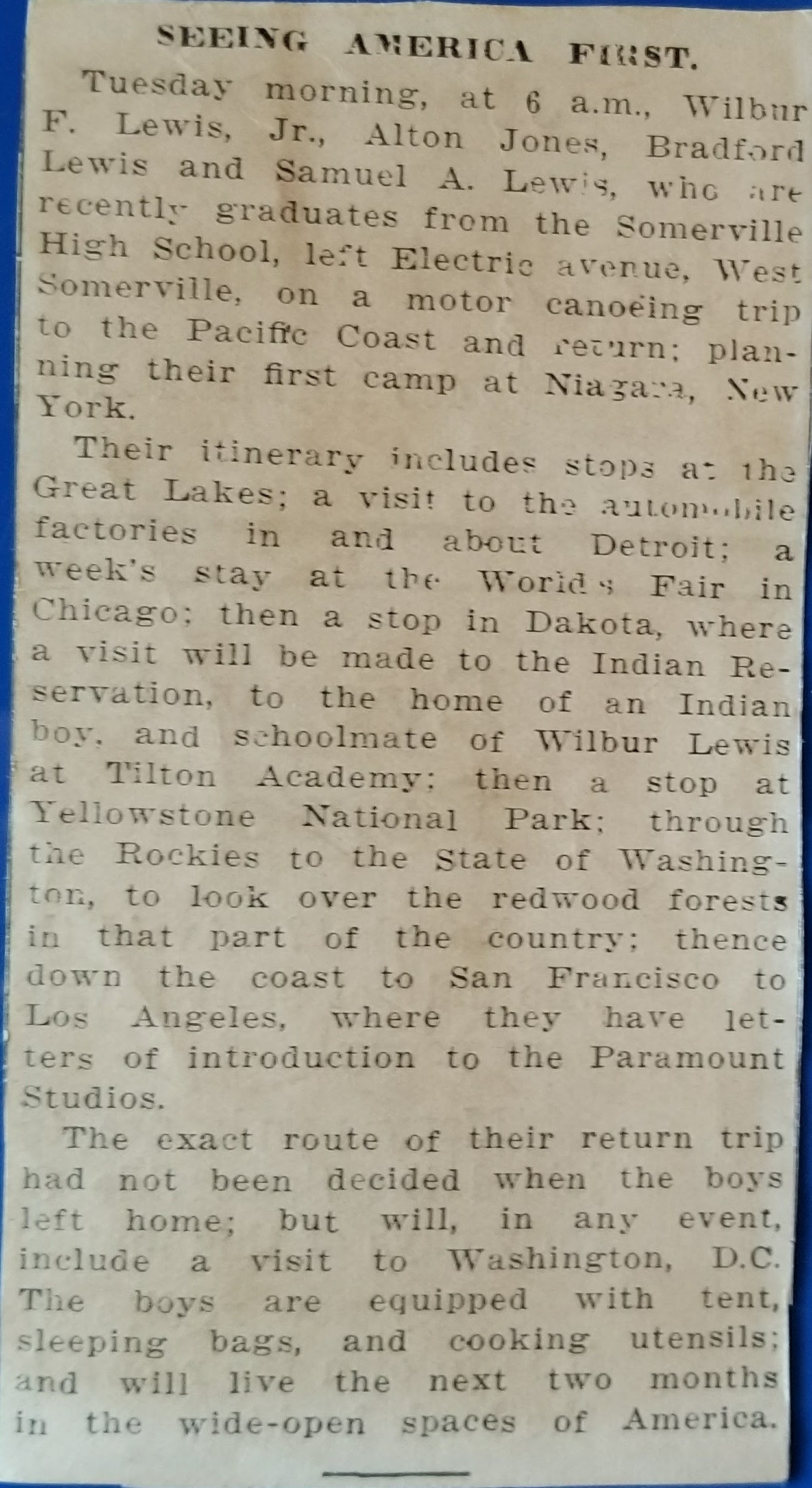
Tuesday morning, at 6 a.m., Wilbur F. Lewis, Jr., Alton Jones, Bradford Lewis and Samuel A. Lewis, who are recently graduates from the Somerville High School, left Electric avenue, West Somerville, on a motor canoeing trip to the Pacific Coast and return; planning their first camp at Niagara, New York.

Their itinerary includes stops at the Great Lakes; a visit to the automobile factories in and about Detroit; a week’s stay at the Worlds Fair in Chicago; then a stop in Dakota, where a visit will be made to the Indian Reservation, to the home of an Indian boy, and schoolmate of Wilbur Lewis at Tilton Academy; then a stop at Yellowstone National Park; through the Rockies to the State of Washington, to look over the redwood forests in that part of the country; thence down the coast to San Francisco to Los Angeles, where they have letters of introduction to the Paramount Studios.

The exact route of their return trip had not been decided when the boys left home; but will, in any event, include a visit to Washington, D.C. The boys are equipped with tent, sleeping bags, and cooking utensils; and will live the next two months in the wide-open spaces of America.

June 1944: Wilbur Lewis, Jr. Is Wounded in Action on Anzio Beachhead

Word has been received by Mrs. Wilbur F. Lewis jr. that her husband has been wounded in the Anzio beachhead campaign, sometime between May 19 and 29.

Pfc. Lewis was a member of a special Commando Platoon of the Infantry. He was inducted into the service in August, 1943, completed his basic training at Fort McLellan, Alabama, and specialized training at Camp Mead, Baltimore, Maryland, and embarked for foreign service in the early part of February of this year. He is now confined to a military hospital somewhere in Italy. From information that can be obtained he is making rapid recovery.

Pfc. Lewis is a graduate of Boston university and is the junior member of the firm, S. H. Lewis and Son, real estate and insurance, located in Davis square, Somerville.

Pfc. Lewis has never seen his daughter, Wendy Gilbert Lewis, who was born on April 20 of this year. Mrs. Lewis and daughter are living with Pfc. Lewis’ parents at 51 Foskett street, Somerville.

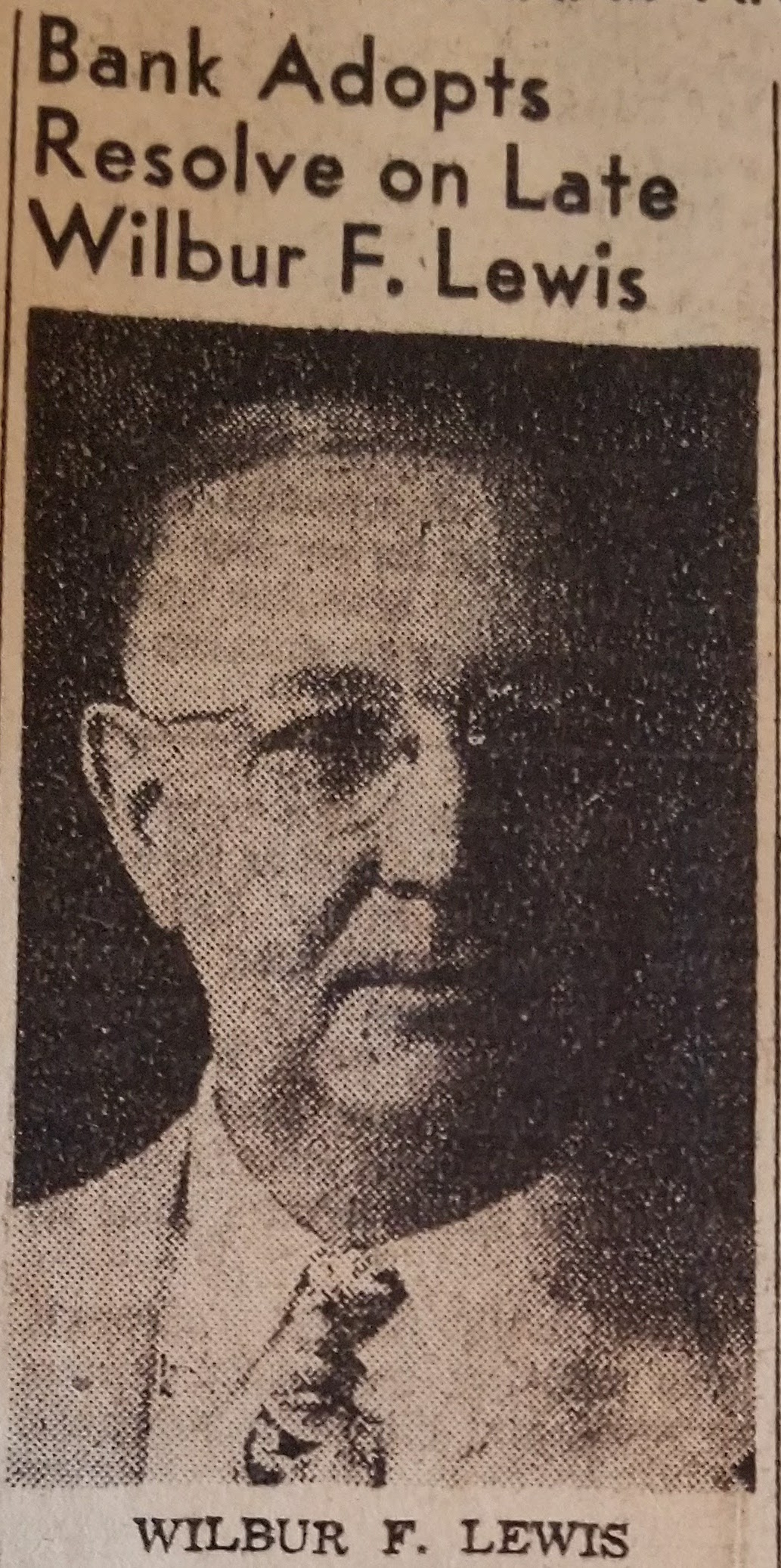
MARCH 1957: Bank Adopts Resolve on Late Wilbur F. Lewis

Messages of sympathy continue to pour in on the family of the late Wilbur Fletcher Lewis, bank president, builder, and for many years prominent in civic and fraternal affairs of Somerville, who passed away on Mar. 6.

A native and life-long resident of Somerville, he had served in the board of aldermen, the house of representatives and on the board of public welfare of his native city. He was in the building business for many years and had built apartment houses and many dwelling houses in Somerville, Arlington, and other sections of Greater Boston.

The Winter Hill Federal Savings and Loan Association, of which he had been president for the past four years and a director, since 1919, adopted in Memoriam, the following resolutions which have been sent to the family.

“Our Heavenly Father, in His Divine Providence, has removed from our midst, Wilbur F. Lewis, president of the Winter Hill Federal Savings and Loan Association for the past four years and a director since 1919.

“He was a man of exceptional ability and determination, a man with good sound judgement, ready and willing at all times to do his utmost for the benefit of this institution.

“He constributed much to the success of our association and his passing is a great loss to the directors, employees and all others who knew him.

“The deep sympathy of the directors is extended to the family of our departed friend.

“Therefore, Be it Resolved, that this Memorial, be spread to his family.”

He was born in Somerville, 68 years ago, the son of the late Stephen H. and Laura B. (Wright) Lewis. He was a graduate of the Somerville High school and Berkley Preparatory School. He served in the Somerville board of alderman in 1916, 1917, 1918, and 1919, in the house of representatives in 1920, 1921, 1922, 1923 and 1924.

After leaving school he entered the building business with his father, as S. H. Lewis & Son, and when his father began to fail in health, Wilbur, took over, for 30 years conducted the business. He built the Powder House Apartments at 119 College ave., the home in which he resided at 51 Foskett Street, and many other dwelling houses in West Somerville and Arlington. He built over 100 houses.

He was noted for his kindness and loyalty to his family and relatives. He was well known in the Davis sq. section, where he was numbered among the “old-timers” and had a wide circle of friends.

The late Mr. Lewis had been a member of the Somerville Lodge of Elks for over 35 years; a lieutenant in the Ancient & Honorable Artillery Co.; Somerville Lodge of Masons, Massachusetts Consistory; Aleppo Temple Mystic Shrine; charter member of the Kiwanis Club of Somerville; Fraternal Order of the Eastern Star; Somerville Chamber of Commerce, College Avenue Methodist church, and a corporiate member of the Fernald School at Waltham.

He leaves his wife, Mrs. Etta E. (Dixon) Lewis, whom he married in 1913; a son, Wilbur Franklin Lewis, and three grandchildren.

Largely attended services were held in the College Avenue Church. Rev. Dr. Guy H. Wayne officiated. Burial was in Mt. Auburn Cemetery, Cambridge.

Lt. Wilbur F. Lewis, Silver Star Winner, Home from Service

Lt. Wilbur F. Lewis, Silver Star Winner, Home from Service
Somerville Press

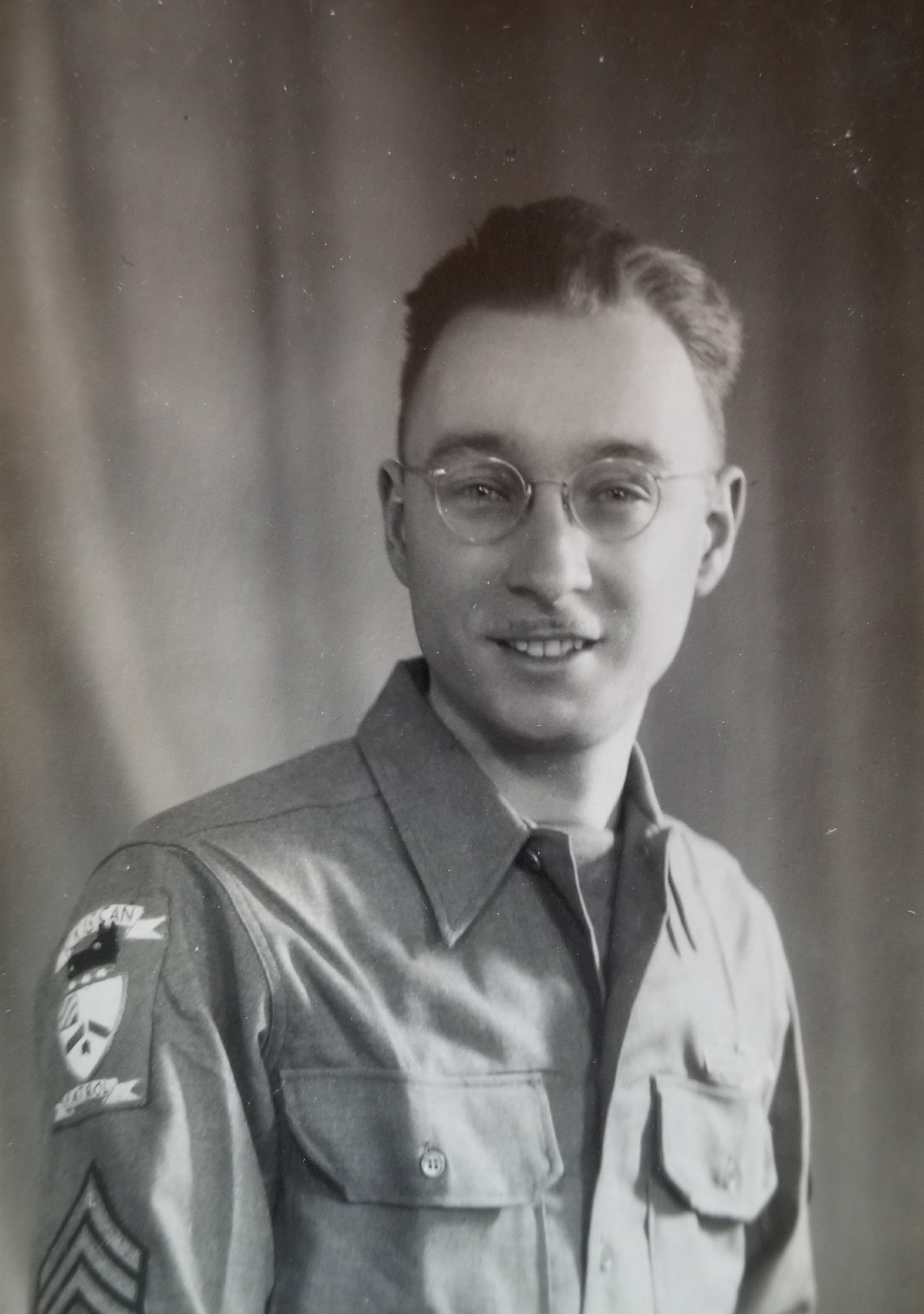
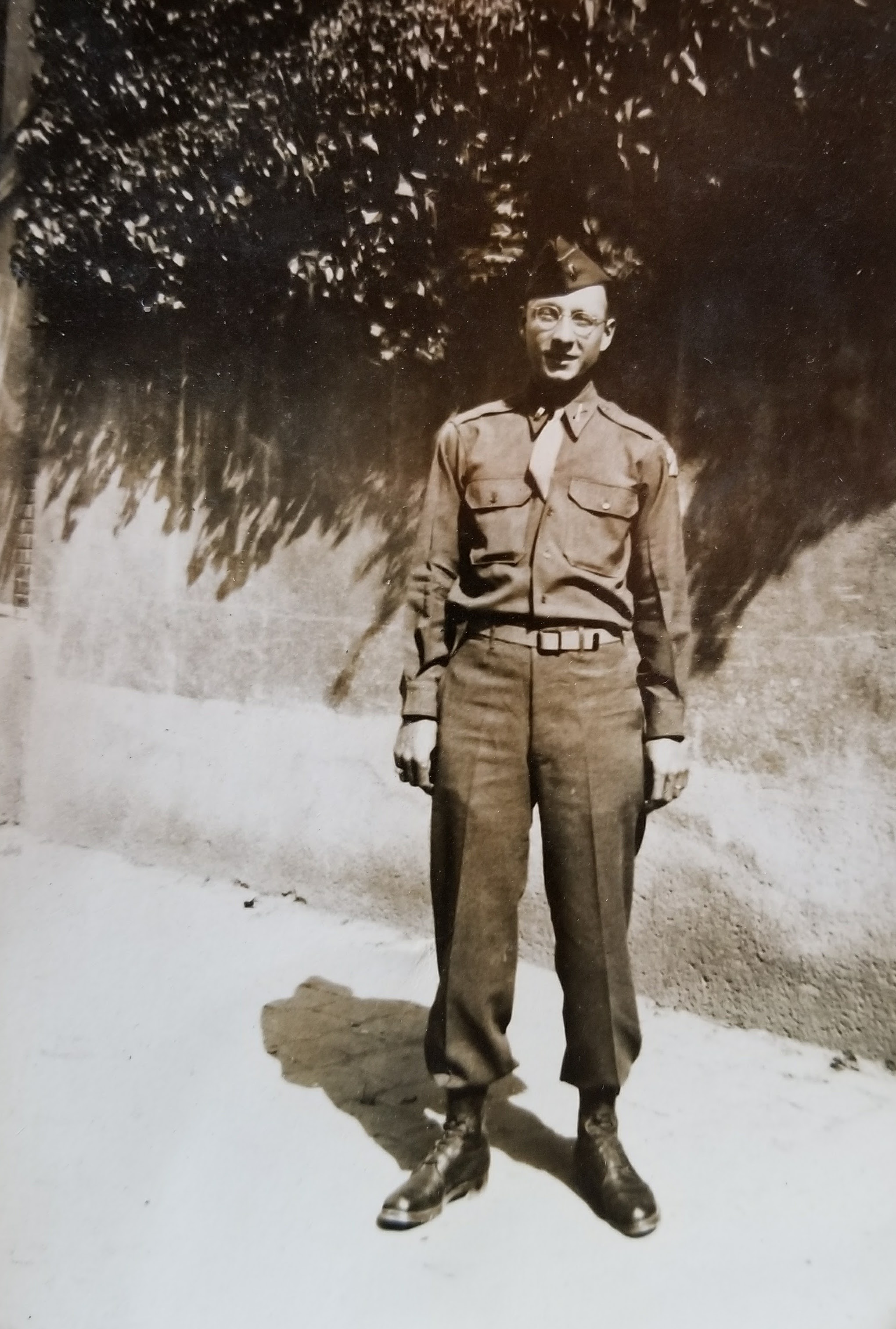
Recently arrived home from two years of distinguished service overseas, combat infantryman Lt. Wilbur F. Lewis, Jr., son of Mr. and Mrs. Wilbur F. Lewis, 51 Foskett Street, West Somerville, is now reunited with his wife, Marion, and his two-year-old daughter, Wendy whom he had never seen.

A volunteer member of a raider platoon, Lt. Lewis fought his way form Anzio Beachhead in Italy to Salzburg, Austria, with the Fame Third Division of the Seventh Army. Fighting under the French First Army in the Colmar pocket in France, Lt. Lewis was awarded the French Fourragères. Later, he received the Silver Star Medal for gallantry in Action in Besancon, France. Other recognitions awarded Lt. Lewis were the Unit Citation with two clusters, the Purple Heart, for wounds received in the drive to Rome, the Infantry Combat Medal, and four battle stars. Lt. Lewis participated in the initial landing in Southern France on August 15, 1944, for which he was awarded the Bronze Arrowhead.

Going into battle as a private immediately on his arrival overseas, Lt. Lewis soon raised himself to the rank of sergeant, and the later received his commission on the field. At the end of the war, Lt. Lewis took an active part in the occupational program of the Third Division as staff officer in the 30th Infantry Regimental School in Eschwege, Germany, after two weeks training in Paris, France.

Following his discharge on February 27, Lt. Lewis will take up his duties as a member of the firm of S. H. Lewis & Son, Builders, Wilbur F. Lewis, Real Estate and Insurance, and the Franklin Realty Trust, located in the Woodbridge Hotel, 23 College avenue, West Somerville.

William H. Hammersley, Sr. – Profile (with death)

From History of Walworth County Wisconsin by Albert Clayton Beckwith, Vol. II,
Publ. 1912 – Page 848-850

william-h-hammersley-srIn the death of William H. HAMMERSLEY, Sr., Lake Geneva and vicinity lost one of its most valued citizens. The latter part of his life, covering over forty years, was spent here and during that time he took an active part in the general progress of the county. He belonged to that type of progressive business men who believe in carrying the Golden Rule into their everyday affairs. Always quiet and unostentatious in manner, he nevertheless left a strong impress of his individuality upon all whom he met. He had the happy faculty of seeing the beautiful things of the world, enjoyed nature, loved flowers, appreciated noble traits in mankind and had an optimistic outlook on life, so that to know him was to respect and admire him for his exemplary characteristics.
Mr. HAMMERSLEY was born January 8, 1832, in Hanley, England, and was the son of William S. and Ann (PEDLEY) HAMMERSLEY. His paternal grandfather, Ralph HAMEMRSLEY, died in England when about seventy-five years old. He was a man of strict integrity, a consistent Christian and for many years was a deacon in the Congregational church.

William S. HAMMERSLEY, father of the subject, was a manufacturer of chinaware in England, which business he followed until 1843, in which year he emigrated to America, locating in New York city, where he became an importer of china and earthenware. In 1855 he moved to Flint, Michigan, and retired from business, and now he and his wife are both deceased; they were members of the Presbyterian church. They were the parents of the following children: Ann Jane, widow of Henry C. WALKER, lives in Ann Arbor, Michigan; William H., of this review; Lucilla Oakley is the wife of Edward M. MASON, of Girard, Kansas;
Fannie is the wife of W. B. BUCKINGHAM and lives at Stevens Point, Wisconsin.

William H. HAMMERSLEY, Sr., was twelve years old when his family brought him to the United States. He had attended school in his native land, and soon after coming to New York he began clerking in his father’s store. When he reached manhood he became associated with his father in business and so continued until 1853. On October 6th of that year he was united in marriage with Elizabeth S. SMITH, daughter of Henry and Phoebe Ann (BARKER) SMITH. She was born in Erie county, New York, near Buffalo, and in her early life the family move to New York City, where she lived until her marriage. Her parents had come from Saybrook, Connecticut, to New York state and settled at Butterworth Falls (correction: Buttermilk Falls, now Highland Falls), near West Point, subsequently moving to Erie county, where Mrs. HAMMERSLEY was born.

In 1863 Mr. HAMMERSLEY and family came to Walworth county and lived a year on the farm. He then went to Lake Geneva and went into business as a dealer in drugs, books and stationery. He had a well stocked store and enjoyed a large trade. In later years he also engaged in the floral business, having charge of the Lake Geneva Floral Company. He was very successful as a business man and was known to all with whom he had dealings as a man of the highest integrity.

Politically Mr. HAMMERSLEY was a Republican and he took more than a passing interest in public affairs, and held a number of township offices, such as township clerk, and he was chairman of the board of supervisors.

Three children were born to Mr. and Mrs. HAMMERSLEY: Grace C. is the wife of C. D. GILBERT, a grocer of Lake Geneva, and they have one daughter, Lizzie; Charles H., who was a florist in Lake Geneva, married Ida C. GILBERT, which union was without issue, and his death occurred in 1894; William H. married Emma M. SEYMOUR and they have three children, Seymour, Henry and Evelyn; he is in the drug business in Lake Geneva, having succeeded his father.

William H. HAMMERSLEY, Sr. was a Royal Arch Mason, a prominent member and officer of the Congregational church, and an earnest Christian. He was one of the prominent and influential men of the southern part of the county, being a man of steadfast purpose in all the relations of life, whether religious or secular, conscientious and faithful to every trust. He was summoned to his reward on April 14, 1906.

Golden Wedding at Fairfax

Golden Wedding at Fairfax

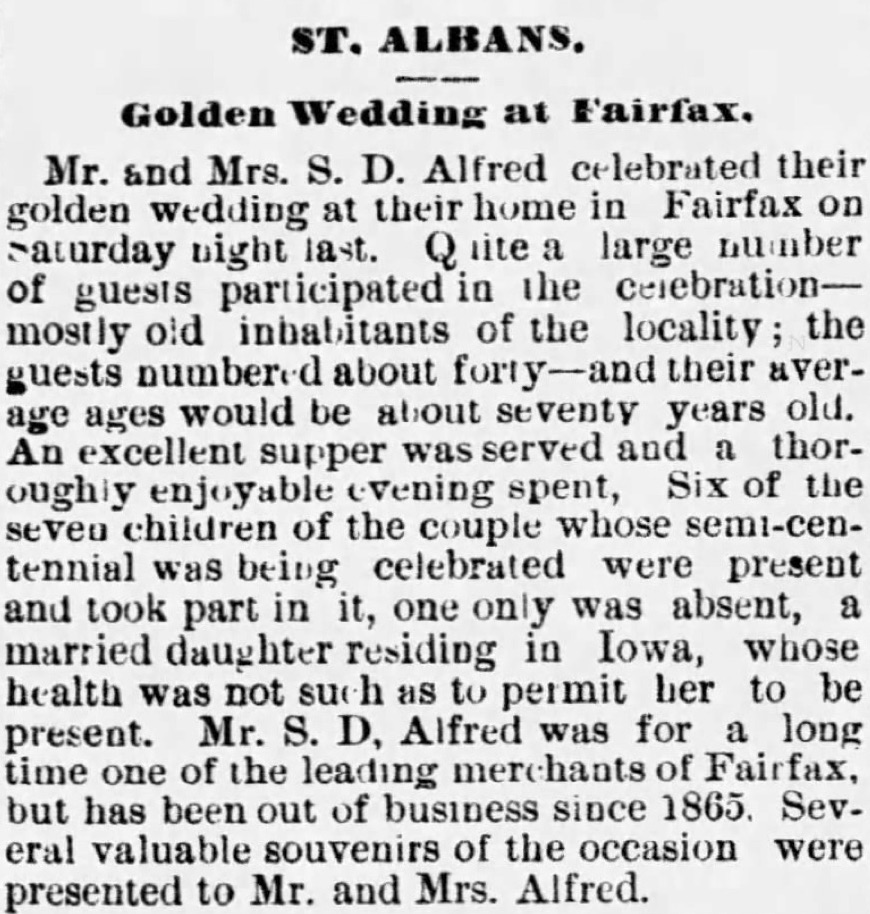
Mr. and Mrs. Samuel D. Alfred celebrated their golden wedding at their home in Fairfax on Saturday night last. Quite a large number of guests participated in the celebration–mostly old inhabitants of the locality; the guests numbered about forty–and their average ages would be about seventy years old. An excellent supper was served and a thoroughly enjoyable evening spent, six of the seven children of the couple whose semi-centennial was being celebrated were present and took part in it, one only was absent, a married daughter residing in Iowa, whose health was not such as to permit her to be present. Mr. S. D. Alfred was for a long time one of the leading merchants of Fairfax, but has been out of business since 1865. Several valuable souvenirs of the occasion were presented to Mr. and Mrs. Alfred.

The Burlington Free Press
(Burlington, Vermont)
29 Nov 1882, Wed • Main Edition • Page 3

samuel_and_polly_alfred_celebrate_their_golden_anniversary

A. S. Alfred, Paper Man, Succumbs

A. S. ALFRED, PAPER MAN, SUCCUMBS
Widely Known Coast Manufacturer Dies Here After Brief Illness

Almon S. Alfred, 85 years of age, of 1500 West Ninth Street, one of the most widely known paper manufacturers and salesmen on the Pacific Coast, died yesterday at his home after a brief illness. He had been a resident of Los Angeles for the past fifteen years, and was prominent in business and civic activities. Mr. Alfred was born in Vermont, where he entered the paper manufacturing business at an early age. For several years he was the personal representative in the United States and foreign countries of one of the largest paper manufacturing concerns in the industry. He leaves two daughters, Alice Alfred of Los Angeles, and Helen L. Alfred of Orange. N. J., and two sons. Clarence and Elbridge Alfred of Orange, N. J. Funeral arrangements have not been completed. The body will be sent to Lake Geneva, Wis., for burial.

The Los Angeles Times
Thursday, April 28, 1932
Page: Page 18