Category Archives: Maternal

Clustering for more on PEI’s William G. Wright

When William George Wright married Sarah Dennis on 28 December 1848, there were two witnesses to the marriage listed on the marriage record: Isaac Smith, Jr. and James Douglas.
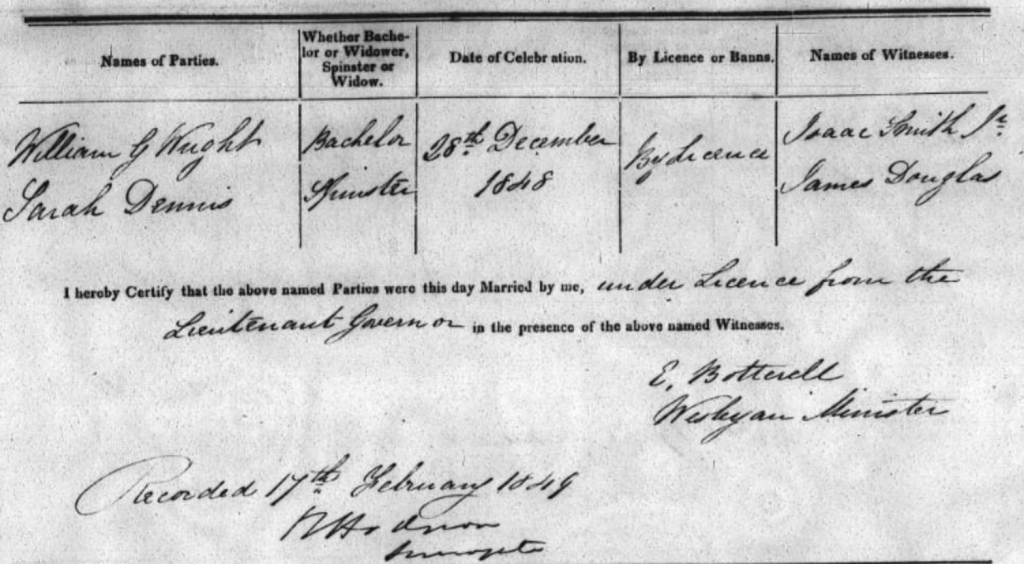
William G Wright Sarah Dennis

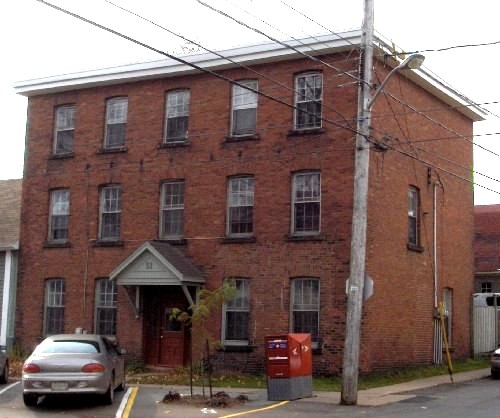
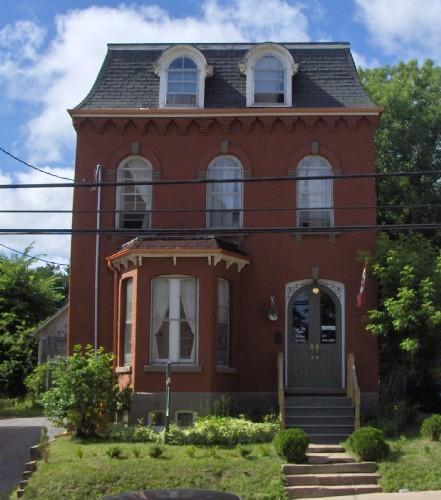
As I have written before (and here and here), William Wright was a carpenter or builder in Charlottetown, and there are several historic houses that can be tied directly to him. Proving that the house builder and the ancestor are the same person isn’t at a 100% “fact” yet, but using some cluster research on one of the names of the marriage witnesses moves it that much closer.
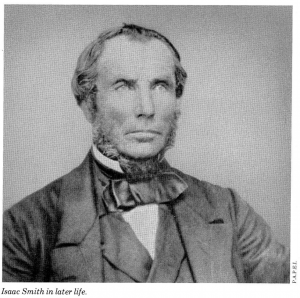
Isaac SmithIsaac Smith, Jr. was born in Charlottetown in 1822 to Isaac Smith and Jane Smith. Isaac, the senior, was one of the most prominent builders, contractors and architects for the capitol region of PEI:

Wherever the future Fathers of Confederation looked in the Charlottetown of 1864, they would have been confronted with the work of builder/architect Isaac Smith. They conferred in a legislative building designed by Isaac Smith. On the same square, coming and going from the sessions which conceived the Dominion of Canada, they could observe an Episcopal church designed and built by Isaac Smith, and a round market house constructed by him. They were feted in a Lieutenant Governor’s residence designed and built by Isaac Smith. The very ship carrying the Canadian delegates had been guided into Charlottetown harbour by a lighthouse designed by—Isaac Smith. (Source)

It would only be appropriate to think that Isaac the son would follow in his father’s footsteps, and the fact that William Wright was is the same business also lends itself to the same conclusion that the witness to my ancestor’s wedding was in fact the son of the famous Isaac Smith. Taking it another step, the same magazine article the above quotation was taken from notes that Isaac Smith worked on several of his projects with one Nathan Wright. Finally, both William Wright and Isaac Smith were lay pastors in the Methodist Church. Could this Nathan Wright be my ancestor William’s father? Did the business (and religious and potentially personal) relationship between Isaac and Nathan directly resulted in the friendship of William and Isaac, Jr.? I, for one, would have to answer yes to both questions.

And now that I am thinking about it, how would have my ancestor Stephen H. Lewis–a much accomplished homebuilder in Somerville, Massachusetts, after emigrating from Nova Scotia–have met William’s daughter Laura when he was born and schooled in Five Islands, N.S.? Well, look at this line from his biography:

Mr. Lewis was employed for two years by an uncle at Prince Edward Island

Eureka!

Though proving Nathan and William to be father and son is still on the docket, there is little doubt in my mind that the Wrights who built many of the great structures of 19th century Charlottetown with the more accomplished Smiths are in fact relatives, if not my direct ancestors.
William S Hammersley – Obituary

Found in The Stevens Point Journal (Stevens Point, Wisconsin) on 3 March 1888 (Page 4):

DIED.

HAMMERSLEY–In Stevens Point, February 28th, 1888. William S. Hammersley, in the 83rd years of his age.

Deceased was born at Staffordshire Potteries, England, August 23, 1805, and when a young man, succeeded his father in the manufacture of crockery at that place. In 1843, together with his wife and four children, he came to New York, where he was engaged in the importation of crockery until 1856. In the latter year he closed out his business and removed to Flint, Michigan, in which city he owned a homestead at the time of his death. His wife died at Flint in 1870. Four children survive him, the oldest, Mrs. H. C. Walker, residing at Ann Arbor, Mich., the second, Mr. Wm H. Hammersley, at Lake Geneva, Wis., the third, Mrs. E. M. Mason, at Girard, Kansas, and the youngest, Mrs. W. B. Buckingham, in this city. Late last summer Mr. H. was reduced very low by an attack of inflammation of the bowels, and Mrs. Mason was called from her home to be with him. He rallied from this sickness and as soon as able to travel was prevailed upon to come to Stevens Point to spend the winter. Before the severe weather came on he walked down town nearly every day, but after the cold weather set in was not outside the yard. He had been gradually failing all winter, until the vital forces refused to do their work, and he calmly sunk into the last sleep last Tuesday at about noon. He was about the house the day before, and retired about the usual hour, but did not get up Tuesday morning. He had been a member of the Congregational or Presbyterian church since boyhood.

The remains were taken to Flint, Mich., Wednesday evening, accompanied by Mr. and Mrs. Buckingham.

Samuel Dwight Alfred – Obituary

The obituary for my 3rd great grandfather–Samuel Dwight Alfred–in the St. Albans Messenger, May 15, 1889 (page 3):

Samuel D. Alfred was born in Springfield, Mass., June 14, 1804. When he was quite young his parents removed to Westfield. At the age of eleven years he lost his father, who was engaged in trading between New York and the West Indies. At 10 he went to Hartford, Conn., where he served an apprenticeship as a cabinet maker, at which trade he worked in Connecticut and New York till 1832, when he returned to Berkshire Centre, where he engaged in the mercantile business and remained for several years. From there he went to West Haven, where he remained only two years. He moved to Fairfax in June, 1842. He remained active is business until the spring of 1865, when he sold out to his son, John B., since which time he has given his time in looking after his farming interest and visiting his children settled in different parts of the West.

Mr. A. was a man very positive in his convictions, whether in regard  to his own or public interests. In business transactions he dealt with the rich and poor alike. A child sent to his store was treated with the same consideration as the most honored citizen. He was interested in education , not only in the common school, but in higher education, as was shown in his efforts combined with so many others to establish and maintain the new Hampton Institute. He always manifested great interest in the welfare of his children, giving them every opportunity for improvement and aiding them in every way by his counsel and advice so long as he lived, and by them will be greatly missed. He was twice married; in 1825 to Miss Sally Willard of Lansingburg, N. Y., who died 1828; in 1932 he married Miss Polly Smith, who, with 7 of their children, still survives him, and with the exception of one all were present at his funeral, which was attended from his late home (which he had occupied for 46 years) Thursday, May 9th, Rev. Henry Crocker officiating, assisted by Rev. J. G. Lorimer, an old friend of the family.

Continue reading Samuel Dwight Alfred – Obituary

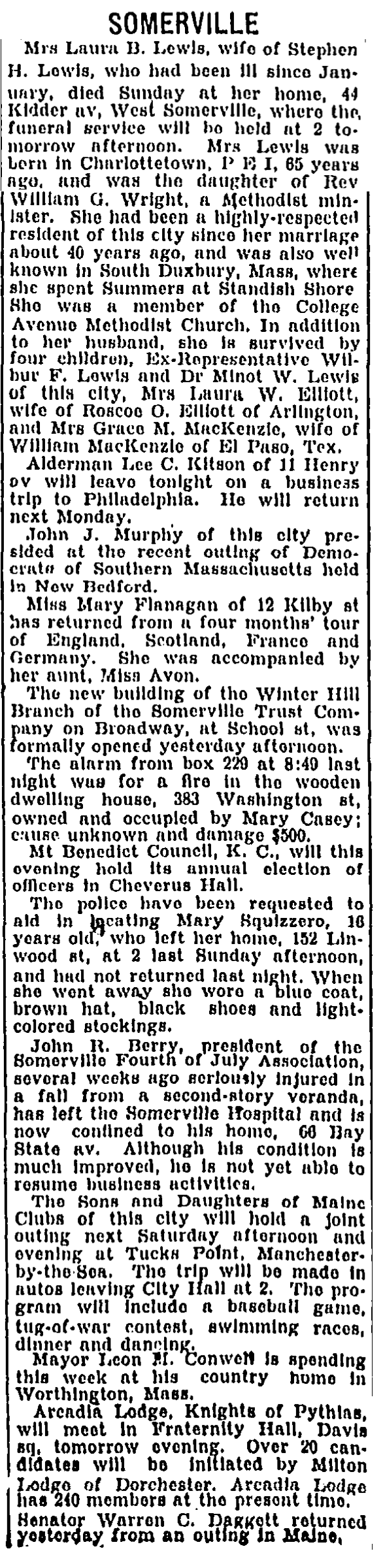
Mrs. Laura B. Lewis (obituary)

Mrs. Laura B. Lewis, wife of Stephen H. Lewis, who had been ill since January, died Sunday at her home, 44 Kidder av, West Somerville, where the funeral service will be held at 2 tomorrow afternoon. Mrs. Lewis was born in Charlottetown, P E I, 65 years ago, and was the daughter of Rev William G. Wright, a Methodist minister. She has been a highly-respected resident of this city since her marriage about 40 years ago, and was also well known in South Duxbury, Mass, where she spent Summers at Standish Shore. She was a member of the College Avenue Methodist Church. In addition to her husband, she is survived by four children, Ex-Representative Wilbur F. Lewis and Dr Minot W. Lewis of the city, Mrs. Laura W. Elliott, wife of Roscoe O. Elliott of Arlington, and Mrs Grace M MacKenzie, wife of William MacKenzie of El Paso, Tex.

Boston Daily Globe
September 14, 1926
Page A12

laura-lewis-obit

Mr. Hammersley on the Ship Thomas P. Cope

William S.  Hammersley “was a manufacturer of chinaware in England, which business he followed until 1843, in which year he emigrated to America, locating in New York City, where he became an importer of china and earthenware.” When he made that transatlantic crossing on 20 May 1843, he seems to have come alone, with his family to follow sometime later.

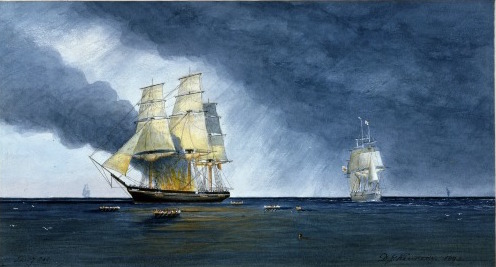
The ship he came on was the Thomas P. Cope:

The Thomas P. Cope was a packet ship that sailed between Philadelphia and Liverpool, making 21 round-trip voyages between 1839 and 1846. In December 1846 the ship was struck by lightning and burned for six days before sinking. (source)

Independence Seaport Museum 014


Cover Photo Source.

51 Prince Street – Built by William Wright

From PEI Historic Places:

WHY IS THIS PLACE IMPORTANT?

The heritage value of 51 Prince Street lies in its role as one of the earliest wooden brick encased buildings in Charlottetown; its Georgian and Italianate influenced architecture; and its role in supporting the streetscape.

51 Prince Street was built for James Costello in 1872. While common now, wooden buildings with an exterior clad in brick were rare in the 1870s. Two factors indicate that the building was originally constructed of wood. When local newspapers described the construction of 51 Prince Street, only carpenter, William Wright was listed as being in charge. If the walls had been load bearing, a mason would have been employed. Also, the fact that the bricks are all laid on their sides and there are no bonding end bricks, indicates that the structure is actually wooden underneath.

The building at 51 Prince Street is Georgian influenced in style but also shows some Italianate influences. The Georgian style is one of the most common architectural styles on Prince Edward Island. It emerged from 18th Century Britain and was intent on expressing confidence, order and balance. Combined with the brick exterior of this building, the result was intended to impress. 51 Prince Street’s Georgian features include the symmetrical facade with five bays and a central doorway. The Italianate style was a more decorative style reminiscent of the Venetian arcades of the Renaissance period. Italianate influences can be seen in the slightly arched windows and the flat roof.

155 Euston Street – Built by William Wright

From Canada’s Historic Houses:

155 Euston Street is a Second Empire style, three storey, former town house located near what was traditionally referred to as Gallows Hill. The large building was constructed in 1875 for the manager of the Guardian newspaper and printer, Joseph William Mitchell (1836-1888) and his wife Barbara Rachel Ann Hooper (1847-1934). The designation encompasses the building’s exterior and parcel; it does not include the building’s interior.

And the Wright connection:

In 1875, the Mitchells’ hired local architect, Richard Weeks to design their home. William Wright was hired as the contractor to build the home that was described in the Semi Weekly Patriot newspaper as a neat, three-storey, brick cottage.

And evidently you can stay there for only $49 per night!

3 Hillsborough Street – Built by William Wright

3 Hillsborough St.

….The Adams family of New London owned this land from the 1820s into the twentieth century. During that time, in 1872, William Adams leased to Charles McFarlane the corner property for 21 years and Mr. McFarlane agreed “to erect a flat roof house”. It appears Mr. McFarlane reneged on the flat roof as, in 1875, builder William Wright constructed a house and shop for Mr. McFarlane, and it seems to be the gable roofed house there today.

(Source: Virtual Tour of Charlottetown, Prince Edward Island)

Tracking Down James Reid

James Reid is my 4th great grandfather, father to Catherine (Reid) Lewis. In Catherine’s obituary, this was written of him:

Mr. James Reid, father of the deceased, was a soldier in the King’s army, and after the Irish rebellion in 1799 was crushed, he came with his family to Canada.

A little more information

Her maiden name was Reid, born at Race End, Donegal, Ireland. The clan from which this branch of the Reid family sprang was noted in Scotland in the seventeenth century. Members of the family lived to the patriarchal age of 90 and 100 years.

Additional Reid family history.

So here are my questions for a professional or more seasoned amateur genealogist than myself:

  1. What is the King’s army that this refers to, and do enlistment records exist for this army?
  2. Would their travel from Ireland to Canada be catalogued somewhere in a passenger manifest (it was likely around 1830)?
  3. What are the records available in Ireland or Scotland during the 18th and 19th century, if any?

With a name like “James Reid,” I am not expecting easy results, or really any results, but if military records do exist, that may be the best chance.

Obituary of Catherine (Reid) Lewis

OBITUARY
_________
Mrs. Catherine Lewis Died at Lyn
Colchester County, June 15
_______________

Mrs. Catherine Lewis died at Lyn Colchester County, June 15, aged 86 years. Her maiden name was Reid, born at Race End, Donegal, Ireland. The clan from which this branch of the Reid family sprang was noted in Scotland in the seventeenth century. Members of the family lived to the patriarchal age of 90 and 100 years. Continue reading Obituary of Catherine (Reid) Lewis