A. S. Alfred, Paper Man, Succumbs

A. S. ALFRED, PAPER MAN, SUCCUMBS
Widely Known Coast Manufacturer Dies Here After Brief Illness

Almon S. Alfred, 85 years of age, of 1500 West Ninth Street, one of the most widely known paper manufacturers and salesmen on the Pacific Coast, died yesterday at his home after a brief illness. He had been a resident of Los Angeles for the past fifteen years, and was prominent in business and civic activities. Mr. Alfred was born in Vermont, where he entered the paper manufacturing business at an early age. For several years he was the personal representative in the United States and foreign countries of one of the largest paper manufacturing concerns in the industry. He leaves two daughters, Alice Alfred of Los Angeles, and Helen L. Alfred of Orange. N. J., and two sons. Clarence and Elbridge Alfred of Orange, N. J. Funeral arrangements have not been completed. The body will be sent to Lake Geneva, Wis., for burial.

The Los Angeles Times
Thursday, April 28, 1932
Page: Page 18

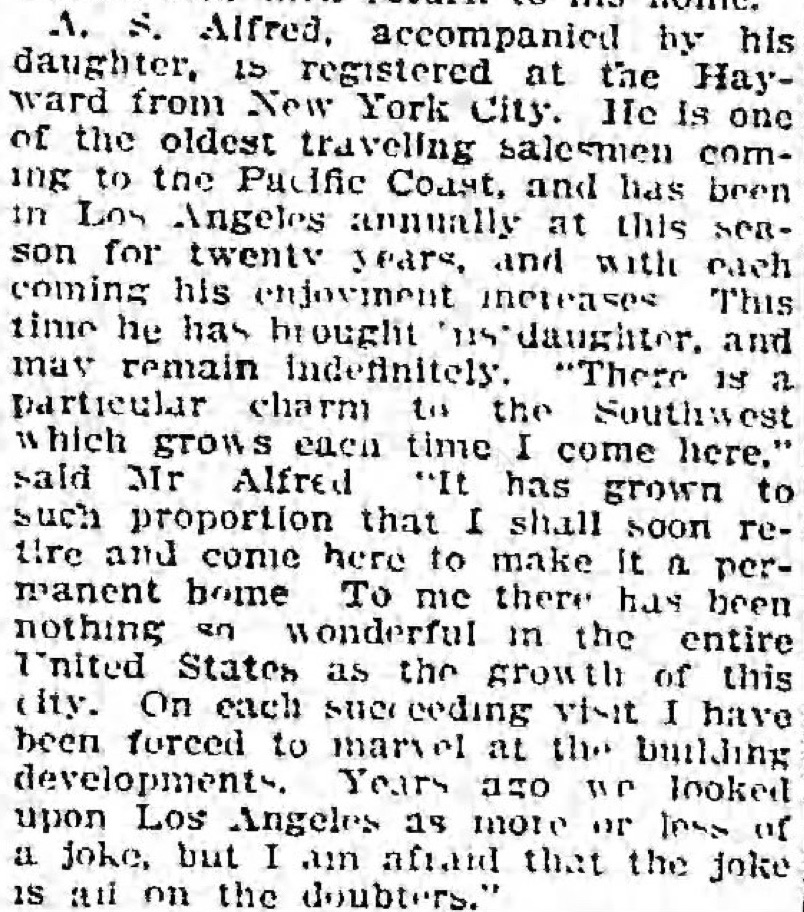
Almon Alfred: “There is a particular charm to the Southwest which grows each time I come here.”

Almon S. Alfred, accompanied by his daughter, is registered at the Hayward from New York City. He is one of the oldest traveling salesmen coming to the Pacific Coast, and has been in Los Angeles annually at this season for twenty years, and with each coming his enjoyment increases. This time he has brought his daughter, and may remain indefinitely. “There is a particular charm to the Southwest which grows each time I come here,” said Mr. Alfred. “It has grown to such proportion that I shall soon retire and come here to make it a permanent home. To me there has been nothing so wonderful in the entire United States as the growth of this city. On each succeeding visit I have been forced to marvel at the building developments. Years ago we looked upon Los Angeles as more or less of a joke, but I am afraid that the joke is all on the doubters.”

The Los Angeles Times
(Los Angeles, California)
23 Jan 1910, Sun • Page 111

wonderful_account_of_almon_alfred__039_s_love_for_the_pacific_coast_

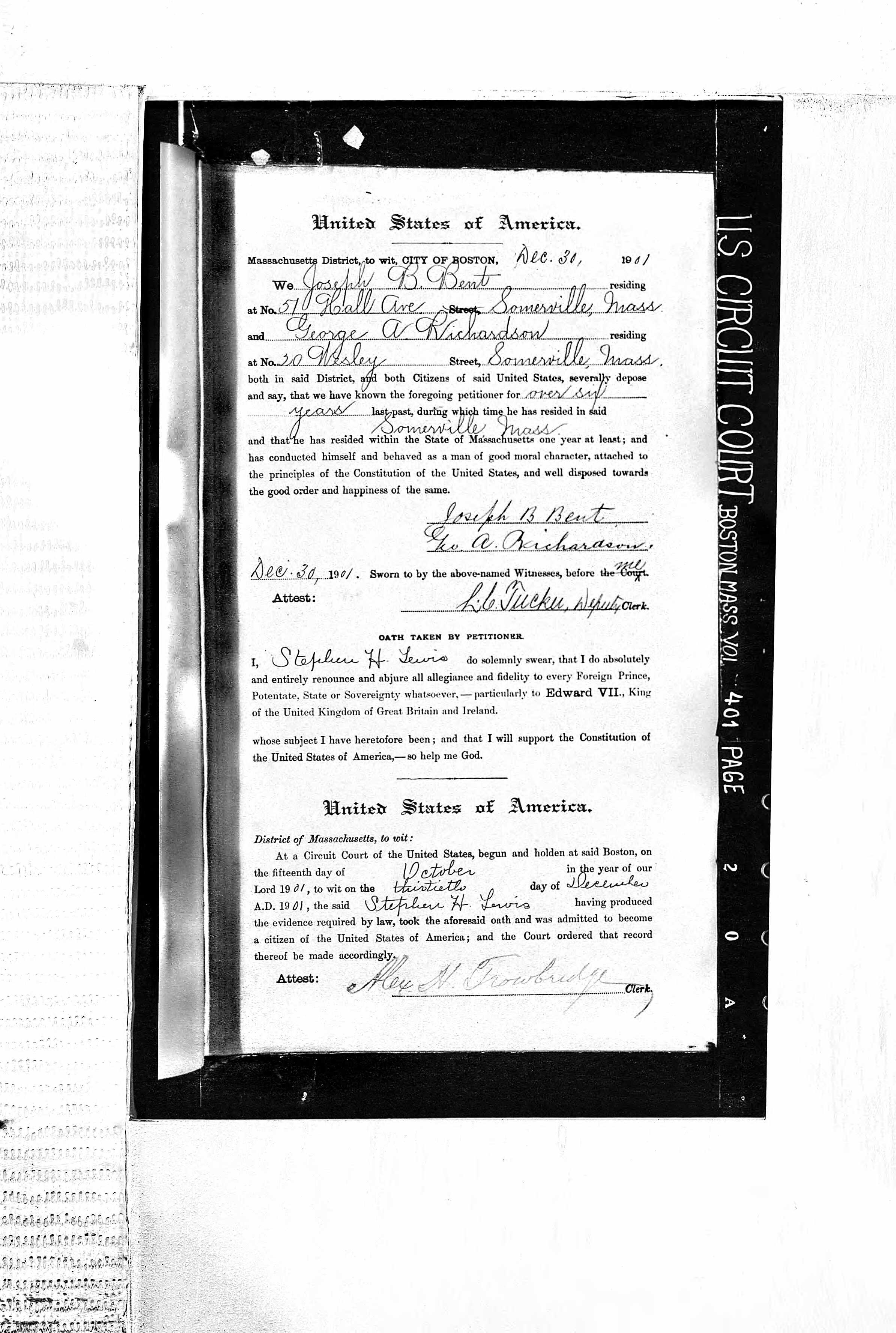
The Arrival and Naturalization of Stephen H. Lewis

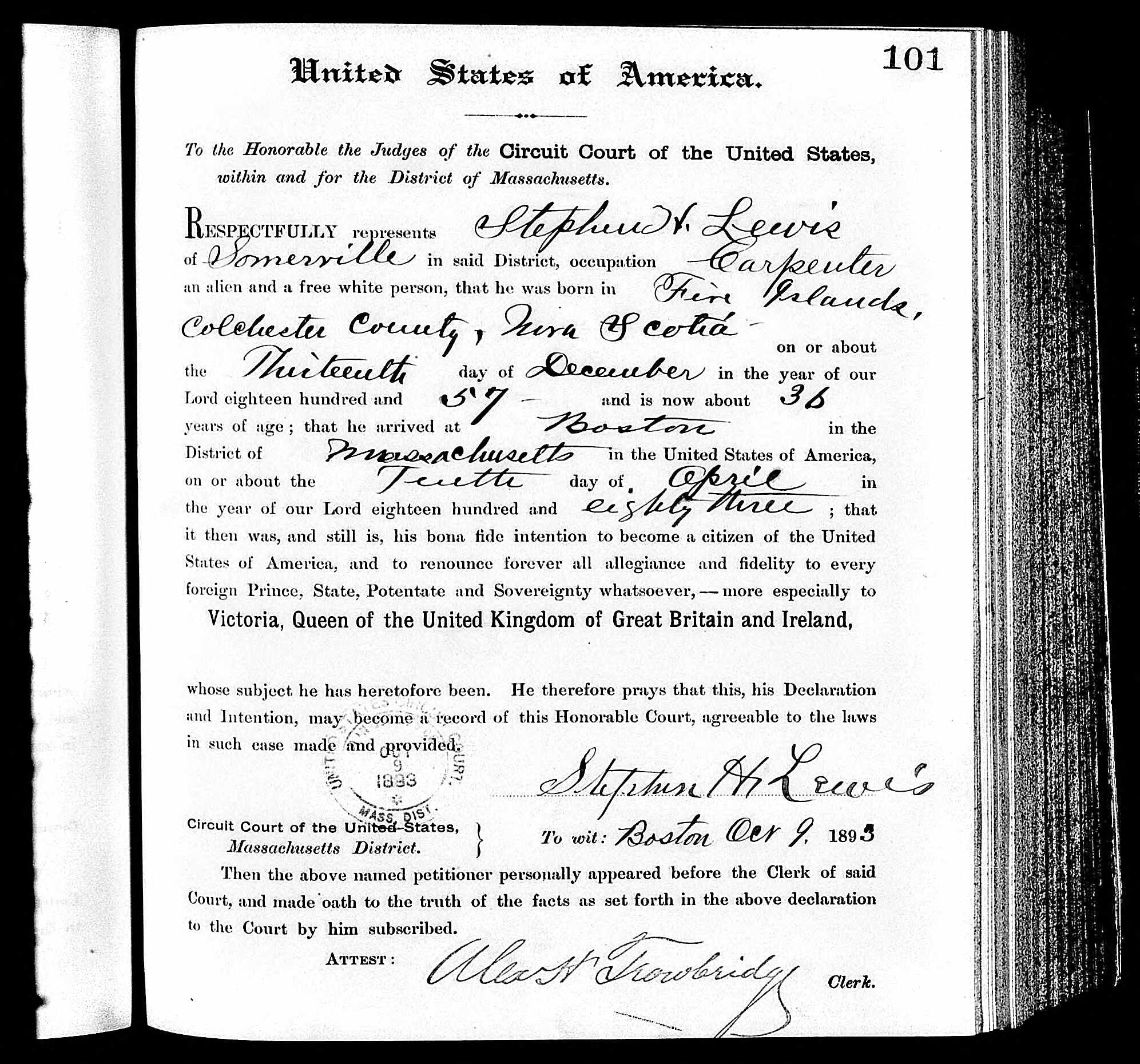
It looks like Ancestry.com has added new naturalization petitions for the Commonwealth of Massachusetts, and it just so happened that I did a new search on Stephen H. Lewis and it revealed three new records with some additional information on his arrival from Nova Scotia.

We already knew his birthdate, though this is yet another citation for it: 13 December 1857. Also added additional citations for birth town (Five Islands), birth county (Colchester), and birth province (Nova Scotia), as well as his occupation in Somerville, Building and Carpenter.

He arrived in the port of Boston on 10 April 1883, and on 9 October 1893, he made his Declaration and Intention to become a citizen of the United States, renouncing “forever all allegiance and fidelity” to Victoria, Queen of the United Kingdom and Ireland.

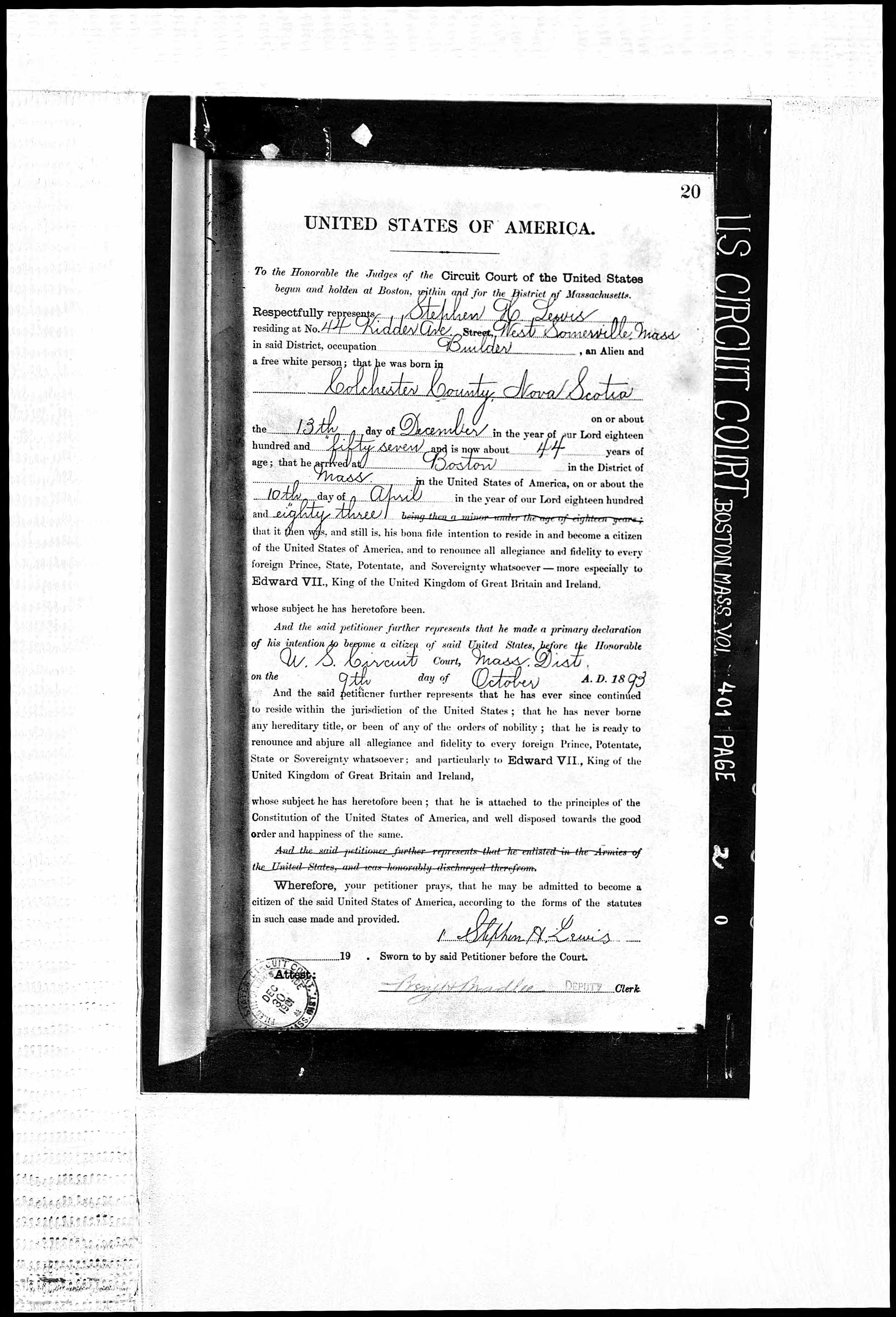
On 30 December 1901, Stephen H. Lewis “having produced the evidence required by law, took the aforesaid oath and was admitted to become a citizen of the United States of America.” He was living at his longtime residence, 44 Kidder Avenue in West Somerville, Massachusetts. An interesting note is that Edward VII was now the King, following the death of his mother, Queen Victoria.

Joseph B. Went (51 Hall Ave, Somerville) and George A. Richardson (20 Wesley, Somerville) were the witnesses.

007774561_00545

007435879_00066

007435879_00067

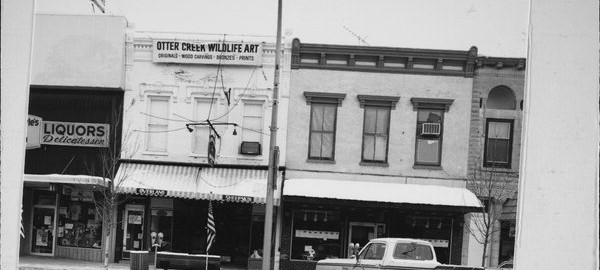
741 Main Street – Hammersley Block

The Hammersley Block is a two-story commercial vernacular building that shares party walls with both of its neighbors. It has a red brick front and is decorated with a pressed metal cornice that features dentils and a sawtooth motif. Above the second story openings are heavy label moldings that suggest the late Italianate style. Openings are filled with single-light sashes. The original storefront of this building was typical of the era: large show windows with transoms, iron columns, and a central entrance. In 1929, though, the building was given a “modern” copper and glass front that has been identified as being from the Brasco Manufacturing Company of Chicago.

The new storefront appears hi a catalog from the Brasco company published in 1927. It features a much deeper central entrance so that the display windows are considerably longer. The storefront has a thin copper framework and low copper aprons under the show windows so that the primary construction material is glass. Above the show windows at the front of the building there is a multi-light transom and between the long show windows there is an arched ceiling. The two entry doors flank a narrow showcase and the entire entrance is topped with a large fanlight. This beautiful storefront is in excellent condition.

The Hammersley Drug Store was one of the most prominent businesses in downtown Lake Geneva. The business began with W. H. Hammersley in 1865, who operated the drug store until 1905, only one year before his death. He was located in the old building on this site, which he replaced in 1885-86. Upon his death, his son, also William H., succeeded him in the drug store. In 1920, his sons, Seymour and Henry, entered the business and operated it until a fourth generation took over, operating the store until the 1980s.

“Forty Years in Business,” Lake Geneva News, 28 September 1905, p. 1; “W. H. Hammersley,” Lake Geneva Herald, 13 April 1906, p. 1; “W. H. Hammersley Associates His Sons With Him,” Lake Geneva News, 8 April 1920, p.l.

The second important and long-time drug store in Lake Geneva was the Hammersley Drug Store. W. H. Hammersley was a native of England who came to the United States hi 1844. He was in business in New York with his father, who imported china and crockery. He remained in this business until 1863, when he came to Lake Geneva. In 1865, he began his drug store business, also selling books and stationery in a small frame building. In 1885-86, Hammersley had a new brick block constructed for his store (741 Main St.) and the business remained in this location for almost 100 years. In 1906, Hammersley’s son, W. H. Jr. took over the business, then passed it on to his sons, Seymour and Henry, who had graduated from the School of Pharmacy at the University of Wisconsin. During the mid and late twentieth century, a fourth generation of Hammersleys carried on the drug store, affiliating with the Walgreen chain. The Hammersley Drug Store stayed in operation into the 1970s.

The Hammersley Block is one of the best-preserved buildings in the historic district. It still retains its 1929 copper storefront and most of its historic second story details. The Hammersley Drug Store was one of the longest and most popular of Lake Geneva’s retail businesses, and W. H. Hammersley Sr. was a prominent member of the community. Because of its long-time association with the Hammersley Drug Store, the Hammersley Block is historically significant for commerce.

[SOURCE]

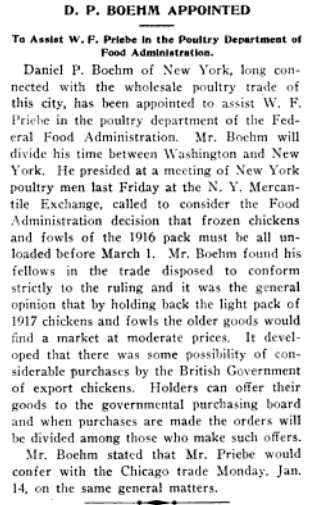
D. P. Boehm Appointed To Assist W. F. Priebe in the Poultry Department of Food Administration

Daniel P. Boehm of New York, long connected with the wholesale poultry trade of this city, has been appointed to assist W. F. Priebe in the poultry department of the Federal Food Administration. Mr. Boehm will divid his time between Washington and New York. He presided at a meeting of New York poultry men last Friday at the N. Y. Mercantile Exchange, called to consider the Food Administration decision that frozen chickens and fowls of the 1916 pack must be all unloaded before March 1. Mr. Boehm found his fellows in the trade disposed to conform strictly to the ruling and it was the general opinion that by holding back the light pack of 1917 chickens and fowls the older good would find a market at moderate prices. It developed that there was some possibility of considerable purchases by the British Government of export chickens. Holders can offer their goods to the governmental purchasing board and when purchasers are made the orders will be divided among those who make such offers.

Mr. Boehm stated that Mr. Priebe would confer with the Chicago trade Monday, Jan 14, on the same general matters.

[SOURCE]
New York Poultry Review and American Creamery, Volume 45
Wednesday, January 16, 1918

DP Boehm Appointed

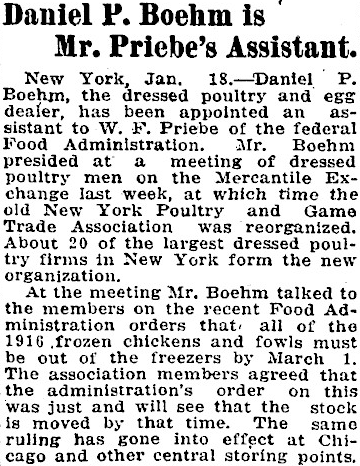
Other coverage of the appointment and meeting [SOURCE: Chicago Packer, 19 January 1918]:

Daniel P. Boehm, the dressed poultry and egg dealer, has been appointed an assistant to W. F. Priebe of the federal Food Administration. Mr. Boehm presided at a meeting of dressed poultry men on the Mercantile Exchange last week, at which time the old New York Poultry and Game Trade Association was reorganized. About 20 of the largest dressed poultry firms in New York from the new organization.

At the meeting Mr. Boehm talked to the members on the recent Food Administration orders that all of the 1916 frozen chickens and fowls must be out of the freezers by March 1. The association members agreed that the administration’s oder on this was just and will see that the stock is moved by that time. The same ruling has gone into effect at Chicago and other central storing points.

Daniel P Boehm Appointed Priebe Assistant

John Henry Boehm – Obituary

OBITUARY
JOHN HENRY BOEHM

The death of John H. Boehm was reported on Monday of this week at his late residence at Climax, in the Catskills, New York State, at the age of 72 years.

Mr. Boehm was born in this city (sic) and was engaged in the poultry and produce business for more than 50 years. He started in Washington Market under name of Boehm & Riley, and later went to Harlem and was in business in 125th Street for a number of years and about 28 or 30 years ago removed to Brooklyn, where he build up a large business in dresses poultry, calves and provisions. He practically retired from active business life a few years ago and purchase a farm at Climax, N.Y., where he resident until his passing away.

Mr. Boehm was married three times and left surviving three songs by his first marriage, Daniel P. Boehm, a prominent dressed poultry and egg merchant of this city and a deputy commissioner of the Federal Food Administration, George and Henry Boehm. A son, Albert, by his second marriage, died a short time ago and by his third wife a son, Ralph, and a married daughter.

The funeral services and burial will take place at Climax, N.Y., on Thursday morning.

[SOURCE]
New York Produce Review and American Creamery, Volume 46

Wednesday, May 1, 1918

John Henry Boehm obituary

Prior to this obituary running, the Review ran this notice:

John Boehm, father of D.P. Boehm of the Federal Food Administration, has been seriously ill at his home in the Catskills and reported to be in a critical condition. Johnny Boehm, as he was familiarly known in this market a few year ago, was a large operator in this market in poultry, calves and provisions, with headquarters in Brooklyn.

[SOURCE]
New York Produce Review and American Creamery, Volume 46
Wednesday, May 1, 1918

John Boehm ill

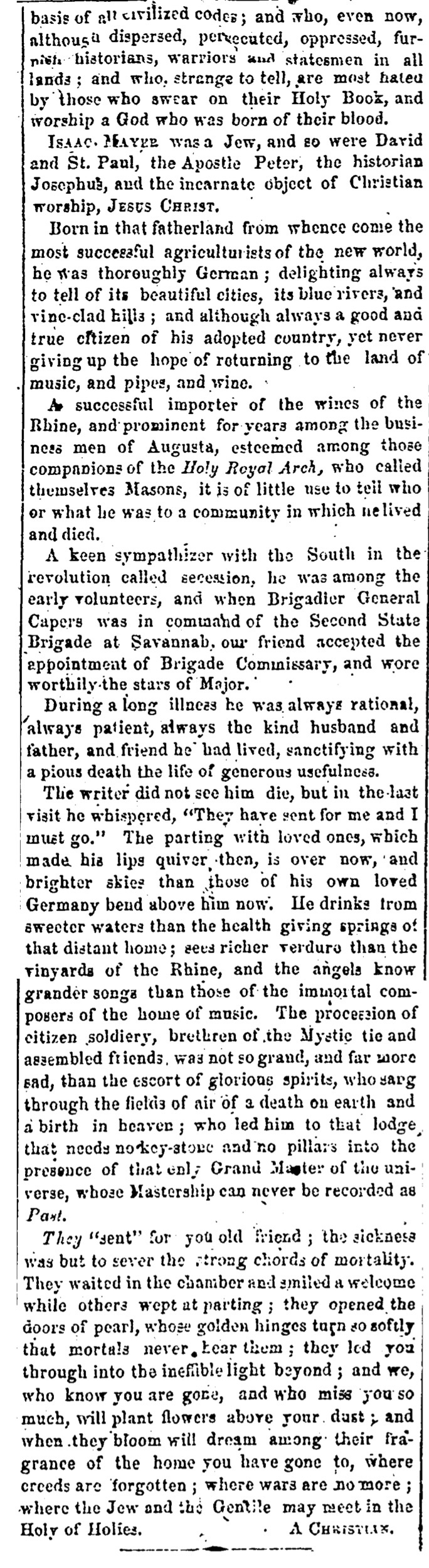
Major Isaac Mayer, obituary

In Memoriam.

Major Isaac Mayer, who died at his residence in Augusta, GA, on the 29th day of April, 1864, in the 46th year of his age.

In terms similar to these we are accustomed to record the passage of all immortals through the shadowy portals which open from earth into the Infinite.

The brief words, he was born, he lived, he died, sum up all human history. The joy which hails the newly born spreads little beyond the household. The mature life may make its energies felt upon the pulses of a world. But whether that life belong to the quiet and unpretending citizen, to the eloquent statesman, or to the mighty conqueror, yet, when the curtain lifts upon the third act of the drama, the shadows of the tomb seem to reach out to darken and obscure. The busy energies of the life in the world contract the narrow limits of the sick chamber. One by one the chords which unite to the busy multitude outside are severed. The silent footfall and sad faces of a few true friends take the places of the joy of life’s morning and the noise and glare of its noon. A mighty angel spreads the shadow of immortal wings above the place, and the great and the humble alike, pass out into the invisible light, even more quietly than they entered the world. Then that world sees in a paper, or hears from the tongue of a bell, or the funeral music of the slow procession, or beholds among the black plumes a hearse; the last words of life’s common history–he died.

The record today is of “an Israelite indeed, in whom there was no guile.” One of that ancient race whose Moses and Joshua, and Gideon and Saul, are prouder and older names than Alexander and Hannibal, Napoleon and Washington.–Whose Oracles, speaking from the Mercy-sect, and beneath the extended wings of the Cherubim, are of authority now, while the groves of Greece, the Delphie Mysteries, the auguries of Rome, as well as those older rites which the Chaldese learned beneath the stars that looked on Babylon, or the Egyptians practiced in the chambers of the Pyramids, only live in tradition and fable.

The race that have preserved amid wars and captivities, the primal history of the world, and the first revelations of its Creator; whose long and authentic genealogies put to shame the boasted ancestry of the noble earth, who are proud to trace their blood from such recent things as a Crusade or Norman invasion; whose deeds of arms live upon the painting and the marble, by which Syria, Egypt and Rome strove to bride the old tomb-builder, Time, into marking his path with something besides dust and decay; whose prophets learned of the future from God; whose Seers talked with Jehovah and his angels; whose poets taught Chilton and Homer to sing; whose kings begun with such names as David and Solomon; whose city was Jerusalem; whose sanctuary was the Temple; whose law is the basis of all civilized codes; and who, even now, although dispersed, persecuted, oppressed, furnish historians, warriors and statesmen in all lands; and who, strange to tell, are most hated by those who swear on their Holy Book, and worship a God who was born of their blood.

Isaac Mayer was a Jew, and so were David and St. Paul, the Apostle Peter, the historian Josephus, and the incarnate object of Christian worship, Jesus Christ.

Born in that fatherland from whence come the most successful agriculturists of the new world, he was thoroughly German; delighting always to tell of its beautiful cities, its blue rivers, and vine-clad hills; although always a good and true citizen of this adopted country, yet never giving up the hope of returning to the land of music, and pipes, and wine.

A successful importer of the wines of the Rhine, and prominent for years among the business men of Augusta, esteemed among those companions of the Holy Royal Arch, who called themselves Masons, it is of little use to tell who or what he was to a community in which he lived and died.

A keen sympathizer with the South in the revolution called secession, he was among the early volunteers, and when Brigadier General Capers was in command of the Second State Brigade at Savannah, our friend accepted the appointment of Brigade Commissary, and wore worthily the stars of Major.

During a long illness he was always rational, always patient, always the kind husband and father, and friend he had lived, sanctifying with a pious death the life of generous usefulness.

The writer did not see him die, but in the last visit he whispered, “They have sent for me and I must go.” The parting with loved ones, which made his lips quiver then, is over now, and brighter skies than those of this own loved Germany bend above him now. He drinks from the sweeter waters than the health giving springs of that distant home; sees richer verdure than the vineyards of the Rhine, and the angels know grander songs than those of the immortal composers of the home of music. The procession of citizen soldiery, brethren of the Mystic tie and assembled friends, was not so grant, and far more sad, than the escort of glorious spirits, who sang through the fields of air of a death on earth and a birth in heaven; who led him to that lodge, that needs no keystone and no pillars into the presence of that only Grand Master of the universe, whose Mastership can never be recorded as Past.

They “sent” for you old friend; the sickness was but to sever the strong chords of mortality. They waited in the chamber and smiled a welcome while others wept at parting; they opened the doors of pearl, whose golden hinges turn so softly that mortals never hear them; they led you through into the ineffable light beyond; and we, who know you are gone, and who miss you so much, will plant flowers above your dust; and when they bloom will dream among their fragrance of the home you have gone to, where creeds are forgotten; where wars are no more; where the Jew and the Gentile may meet in the Holy of Holies.

A. Christian

Wednesday, May 4, 1864
Daily Constitutionalist (Augusta, Georgia)
Volume: XXI Issue: 106 Page: 2
isaac-mayer-obit-01

isaac-mayer-obit-02

The Oblong

It is fascinating when you come across something–in this case a place–that you had never heard of before. In a death notice, the father’s birthplace was listed as “Oblong,” Mass. — just like that, in quotation marks. And whether it was added at the same time or at some point down the line, it was clarified as the S.W. corner of state.

jones-oblong

What the heck?

At first, Google was unhelpful as I searched for an Oblong, Massachusetts. But I started to massage my query, looking at a modern map and seeing Mount Washington as being the town in that corner of Massachusetts. Eventually, I came upon this link that was finally referencing something called the “Oblong.” Love how the blogger starts the post:

I love a good border dispute. (Not a fan of the bad ones of course.) And I really love when the combination of a 200+ year Connecticut border dispute, a great hike, some perambulation fun, multiple geographic extremes, absurdity, a great word like “oblong”, found money, blueberries and upsetting those weirdo genealogy freaks all come together in one CTMQ page…

A page about a 4 foot pillar in the woods.

The pillar he refers to was set in August 28, 1899, in the same location as a stone heap made by the New York-Connecticut Commission of 1731 to mark the northwest corner of the “Oblong.” It all comes down to a border war between New York and Connecticut that ended with Connecticut getting its panhandle, and New York getting the so-called “Oblong.” More from CTMQ and the Connecticut State Library:

So in 1683 the boundary between Connecticut and New York was generally recognized as a line parallel to and twenty miles from the Hudson River north to the Massachusetts line. However, New York, acknowledging most of Connecticut’s settlements in (now) Fairfield County, gave up a claims to a 61,660 acre rectangle east of the Byram River, which became the area sometimes referred to as Connecticut’s “panhandle” or the “handle of the cleaver”. In return, (This would be the Greenwich, Stamford, Darien, New Canaan bit.)

Connecticut gave up its claims to Rye (no loss there) and ceded to New York a strip of land 580 rods (1.81 miles) wide “equivalent” to the area of the panhandle that extended north from Ridgefield along Dutchess, Putnam, and Westchester Counties, New York, to the Massachusetts line. This territory came to be known as “The Oblong”.

As you can imagine, genealogical research for this area is difficult to say the least. Some information may be in Connecticut records, other information may be in New York town or county records, and there are some people and families that either were simply missed or chose to be uncounted. “Lost to the Oblong,” so they say.

As far as Silvanus Jones being from the “Oblong,” that research continues, because I have always been under the assumption he was from the Cape or southeastern Massachusetts.

Obituary for Benjamin Alford

Died, in this city, on Saturday, the 17th, after a short but severe illness, Mr. BENJAMIN ALFORD, aged 46 years, a native of Westfield (Mass). During a short resident in this city, he was much respected by all who had the pleasure of his acquaintance. The warmth and sincerity of friendship, and the benevolent disposition of this gentleman, will endear his memory to his friends and distant relatives and leave them grounds to hope, that he is now enjoying felicity, in another and a better world.–Museum.

Savannah Republican and Evening Ledger
October 1, 1814
Page 3