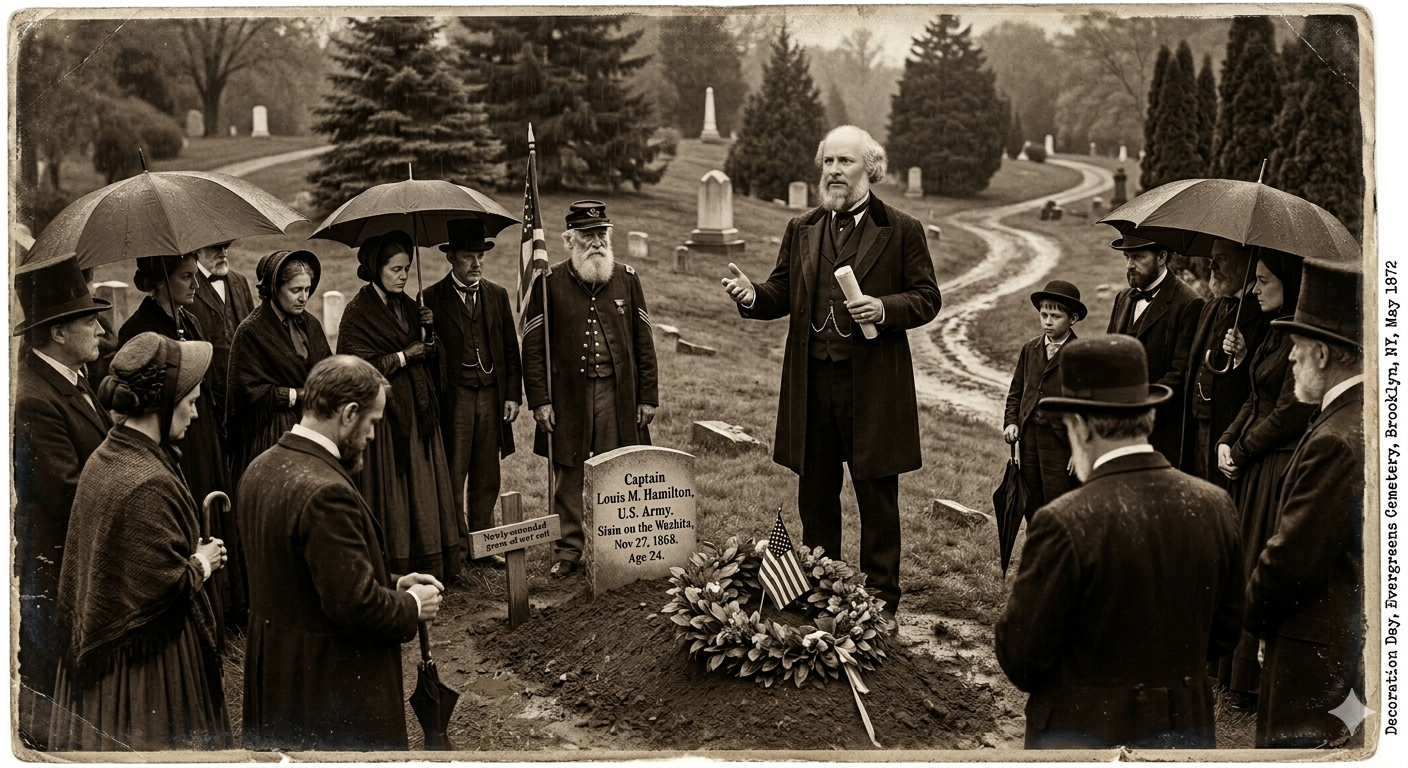
A Decoration Day (what we call Memorial Day today) ceremony was held at the Evergreens Cemetery in Brooklyn, New York, in May 1872, and written about in the Brooklyn Daily Times on May 30, 1872. The ceremonies, which were attended by scores of people, took place at the grave of Captain Louis M. Hamilton, “who distinguished himself in the war of the Rebellion, and was afterward slain while fighting the Indians on the Washita.” At the time of his death, he was only twenty-four years of age. Both his mother and father (Judge Phillip Hamilton, was the son of Alexander Hamilton, a founding father of the United States and member of President George Washington’s cabinet) were in attendance.
After a procession through the area streets, Dr. John Ives, my 3x great-grandfather and a resident of East New York, delivered an oration at the gravesite. He was 59 years of age at the time. Here is that oration:
Fellow Citizens and Members of the Grand Army of the Republic: In common with those whose sympathies are enlisted in behalf of the defenders of our beloved country, we are here to accommodate a sense of duty, to assist in paying a small tribute of respect not only to the dead patriots, but to the living ones. To the living we can be of real and pecuniary service. We can minister to their necessities, for it happens that many of them are poor in purse though rich in devotion to country. Very many of them sacrificed all but life, in defence of liberty, and the equality of all men before the law. Let us, then, pay a passing tribute to their worth, to their heroism, to their devotion to principle, while we garnish the graves of the dead hero. Well I remember how, with banners flying, with high hopes and zeal to punish the audacious insolence of the rebel clan, you bid adieu to your loved at home to defend your insulted flag; and well you did it; and a grateful country’s benediction rests upon you. We rejoice to-day that we have a country, that we have a flag—through your interposition. We rejoice in the fact that you live to enjoy the fruits of your labor; that through your toils, through your privations, soldiers and civilians alike can claim one undivided country and one honored flag.
Yet, while we rejoice, we are saddened by the thought that so many of your brave comrades perished upon the field of battle—and this assemblage, this impromptu gathering of the people, of sire and son, of matron and maid, and veteran soldiers around the resting places of our heroic dead, to drop the tear of sympathy, and to strew garlands and evergreens upon their graves, shows that love and gratitude for noble deeds springs perennial within the human breast, that acts of valor and devotion to country can never be forgotten. It demonstrates still another fact, that man is capable of unselfish and ingenuous impulses.
The dead hero returns no awards, he is uninfluenced by threat or moved by flattery, the gentle zephyr and fierce hurricane are alike to him; they pass unheeded by. He sleeps the sleep that knows no waking till the archangel’s trump shall bid him awake to life again.
This ingenuousness referred to is to the nation another bow of promise, set in our political firmament in token that neither the oppressor nor the enslaver, nor the rebel chieftain, nor any other combination of designing men, can assail our country’s flag and go unharmed. Those who know the way will lead, and thousands will follow them to victory as in the past.
The thought which culminates in setting apart this day in commemoration of the bravery, the toils, the sacrifices, and sufferings of our noble dead was grand and patriotic. While we look upon these silent monuments, while we view the green sod overlying the crumbling remains of sleeping heroes, our minds revert to the days of strife, of carnage, and of dire war; when the whole earth seemed to tremble beneath the majestic tread of contending millions. It was then the hearts of the timid quailed for very fear, and their knees knocked together as if beating the tattoo of departing loyalty. It was said by one highest in authority in the land, that there was no power in the government to coerce the seceding states. Another preached the strange doctrine to the people that the rebel states had a right to secede, if a majority desired it, and in a paroxysm of chivalrous intent cried out “let the wayward sisters go.” The one was repudiated by the people, the other is only awaiting his turn. But you, veteran soldiers, maimed and scarred in your country’s cause with the dead heroes around me, you bared your breasts to the insolent foe, you feared not their menace, but said defiantly—shoot through us at our country—over our prostrate and bleeding corpses you shall creep before you can devastate our homes, our firesides — that flag we defend was never made to be trailed in the dust by rebel hands. The scenes enacted at Corinth, Donaldson, Vicksburg, “The battle above the clouds,” Gettysburg, the march from the mountains to the sea, the struggle through the Wilderness, the final triumph, all pass swiftly in review before us to-day, and while we rejoice that peace has been restored, we can but mourn the loss of our comrades dead. We have not only a duty to perform to the living and the dead heroes of the war, we have a duty to perform towards the orphans left a legacy to the nation. They, too, must be cared for. I bespeak for them the fostering care of the philanthropic and the good. Have them cherish a love of country; let them be taught to reverence the flag their fathers died to protect.
Sir, there is a time for gladness; there is another when the soul cannot conceal its bereavement and sadness—that time is upon us now, and we visit the city of the dead to pay our respects due to glorious deeds, and strew forget-me-nots upon the graves of our departed heroes—who, in defence of Truth against Error, Right against Wrong, died that this Republic of ours might live on, one, inseparable and indivisible, now and forever.
Hail, auspicious morn, in joy we greet thee.
Our strifes are ended, our country is free.
Let the tidings ring out the wide earth around,
The rebels are vanquished, their last ditch is found.

