Born June 24, 1889 — remembering my great-grandaunt on her birthday

If you had walked into a public hearing on slum clearance almost anywhere in America in the 1930s — Detroit, St. Louis, Boston, Memphis, New Orleans — there’s a good chance you’d have found a small, matronly woman in a felt hat at the front of the room, armed with statistics and an unshakable conviction that decent housing belonged to everyone. That was Helen Lillian Alfred: settlement worker, lobbyist, editor, and one of the quiet engineers of public housing in the United States.
She was the sister of my great-grandfather, Clarence J. Alfred, which makes her my great-grandaunt and a quietly remarkable person in our family tree.
From Lake Geneva to the Lower East Side
Helen was born on June 24, 1889, in Lake Geneva, Wisconsin, into a comfortable family. Her father, Almon S. Alfred, was a traveling salesman for the fine-paper firm George B. Hurd & Co.; her mother was Lucy Ives Alfred. Helen could have settled into a quiet, well-provided life. Instead she trained at the New York School of Social Work, served in canteen work for American troops in France during World War I, and then took charge of Madison House, a settlement house on New York’s crowded Lower East Side run by the Ethical Culture Society.
It was there, among the tenements, that she reached the conclusion that shaped the rest of her life: charity and social-service palliatives treated the symptoms, but the disease was housing itself. She went to Europe to study how cities there were already building decent homes for working people, came home, and threw herself into the problem. In 1932 she put her argument into print in a pamphlet titled Municipal Housing, published by the League for Industrial Democracy, a copy of which still survives in library collections today.
Building a movement
In 1931, the reformer Mary Kingsbury Simkhovitch founded the National Public Housing Conference (later renamed the National Housing Conference), the first independent national coalition of housing reformers. Helen was an early member and soon became its secretary and executive director, running the office at 122 East 23rd Street in Manhattan and editing the movement’s bulletin, Public Housing Progress.
This was the engine room of American housing reform. The organization helped persuade the Roosevelt administration to fold housing into early New Deal recovery programs, and it drafted the Wagner housing bill — the legislation that became the Wagner-Steagall Housing Act of 1937 and created the U.S. Housing Authority. Helen and her colleagues lobbied for it relentlessly. As she put it, the group “frankly says it is out with any possible weapon” to get the bill passed. Closer to home, the legislative groundwork she helped lay produced New York City’s very first public housing.
When the conference convened its first national gathering in Washington at the Willard Hotel in January 1934, drawing delegates from some thirty-five cities and nearly a hundred organizations, it was Helen who set the tone. She made the case for housing as a permanent public service rather than a passing emergency measure, but her sharpest point was about people, not policy: creating housing agencies and winning over public officials, she warned, was only half the battle, because “the determining factor in any worthwhile social movement is united action” within a community itself. Government willingness to act meant little, she argued, without an organized public to demand and sustain it — and she closed with a rallying cry for exactly that kind of grassroots organizing.
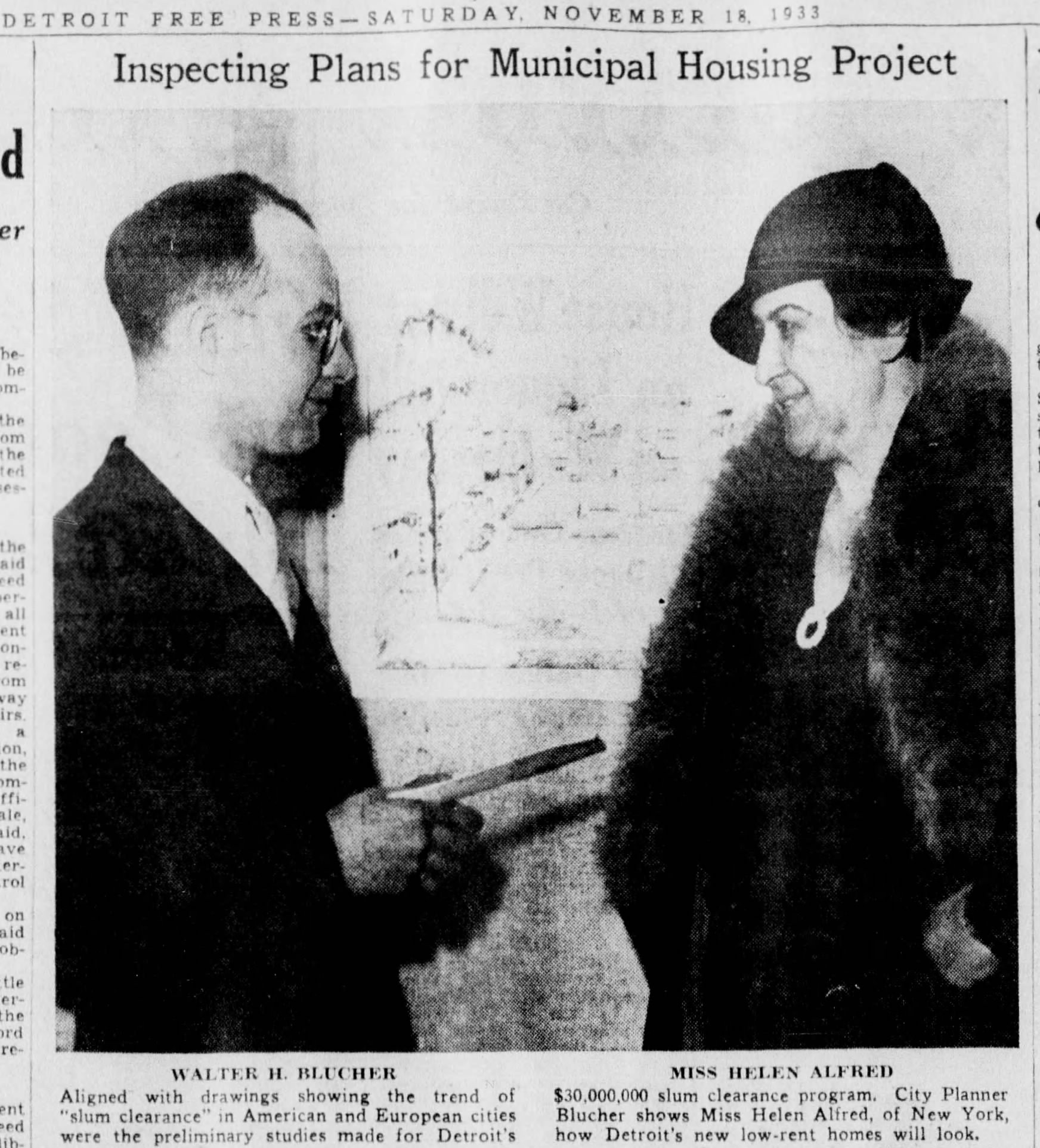
She was tireless on the road. She held conferences “in dozens of American cities” to stir up local support for slum clearance, touring through the South — Richmond, Charleston, Savannah, New Orleans, Birmingham, Nashville, Louisville — and across to the West Coast. In Detroit she championed the embattled Chandler Park project and was photographed studying the drawings for the city’s new low-rent homes. In Boston she declared the North End the worst slum she had ever seen, its crowding and filth “beyond description.” In St. Louis, Los Angeles, and Memphis she warned that America was decades behind Europe and pressed for permanent programs.
Her allies were formidable. Eleanor Roosevelt was among the earliest members of her organization. In her syndicated “My Day” column for April 13, 1936, the First Lady recorded cutting a horseback ride short to hurry home and see “Miss Helen Alfred who wanted to talk over some housing problems.” Senator Robert F. Wagner championed her cause in Congress, and the conference was received for tea at the White House. And Helen had a gift for the memorable line. People used to tell housing reformers to “go back to Moscow,” she liked to say — but by the late 1930s the movement they’d built had become, in her wry phrase, “almost disgustingly respectable.”
A matter of principle

Helen’s commitment to fairness didn’t stop at the front door. In the summer of 1951, at the height of the McCarthy-era Red Scare, a friend of hers — Simon W. Gerson, a New York Communist Party figure she had known since 1933, when he did publicity work for the housing movement — was jailed under the Smith Act. The bail fund that would normally have helped him had been shut out by the courts. So Helen, a former member of the Daughters of the American Revolution who was not herself a Communist, stepped forward and posted $10,000 of her own money to free him.
The reporters who came to her South Orange, New Jersey home couldn’t quite make sense of it. Her answer was simple: “Bail should be easily available, as stated in the Constitution.” When a prosecutor pressed her about her own politics, she shot back that asking whether she was a Communist for posting Gerson’s bail made about as much sense as asking a notorious gangster whether he used drugs. “My family came over from England 300 years ago to escape persecution,” she reminded a reporter — and the initials D.A.R., after all, stand for Daughters of the American Revolution.
It was, in its way, the same conviction that drove her housing work: that the protections and dignities a country promises on paper have to be made real for ordinary people, even (and especially) when it’s unpopular.
Later years
In her later decades Helen’s politics moved well to the left toward the very ideas her opponents had once flung at the housing movement as an insult. She edited essay collections titled Toward a Socialist America (1958) and Public Ownership in the U.S.A. (1961), was for a time a part-owner of the Communist Daily Worker, and lent her name as a sponsor of the American Institute for Marxist Studies; by the end, her causes ranged across civil rights, world peace, and Marxism. She remained active, too, in the League of Women Voters and was a member of the Unitarian church in Santa Barbara, California, where she spent her final years. She died there on February 23, 1966, at the age of 76, after suffering a stroke. A memorial service was held that spring back home in Lake Geneva, Wisconsin, where her story had begun.
My commentary
It’s easy for a name on a family tree to stay just a name. But Helen Alfred spent her life on a question we are still arguing about today: whether a safe, affordable home is a privilege to be earned or a right to be guaranteed. She didn’t only believe the latter — she organized, lobbied, traveled, wrote, and, when it counted, put her own money and reputation on the line for it.
I didn’t fully appreciate the echo until I looked back at my own career. For four years I worked in the Massachusetts Governor’s Office under Charlie Baker, and for three more in what was then the Executive Office of Housing and Economic Development. The work that filled those years turned out to be Helen’s work, carried forward a few generations. I was proud to help advance Governor Baker’s housing agenda: the largest housing bond bill in Massachusetts history at the time, the “Housing Choice” reforms that finally let cities and towns approve new housing by a simple-majority vote instead of a supermajority, and the MBTA Communities law, which presses communities to zone for the multifamily housing our state so badly needs. And when COVID-19 hit and people’s jobs and paychecks vanished overnight, I was there as we worked to keep families in their homes.
Helen spent the 1930s insisting that decent housing was a national responsibility and that government had to help lead the way; I spent the 2010s and 2020s working on the zoning, the financing, and the emergency aid meant to make some of that real. Her 1934 warning that standing up housing agencies and winning over officials was only half the battle, and that the decisive half was whether a community would unite and act landed on me with ninety years of hindsight. The MBTA Communities law proved her point exactly. Passing it on Beacon Hill was the easy part; the hard, human half has played out since in town meetings and zoning fights across the state, community by community. Whether the housing actually gets built is still being decided. Same fight, same conviction, just a different desk, the better part of a century on. I’d like to think she’d have approved.
Happy birthday, Aunt Helen. The fight you gave your life to isn’t finished, but it’s a good deal further along because of people like you.
Sources
Helen’s own words and writings
- Helen Alfred, Municipal Housing (League for Industrial Democracy, 1932). Preserved in the HathiTrust Digital Library.
- Helen Alfred, address to the first Washington Conference on Public Housing, Willard Hotel, Washington, D.C., January 27, 1934. Text published by the National Housing Conference (2022).
- Helen Alfred, ed., Toward a Socialist America (1958), Public Ownership in the U.S.A. (1961), and World Trade for Peace (1964).
Contemporary accounts
- Eleanor Roosevelt, “My Day,” April 13, 1936, The Eleanor Roosevelt Papers Project, George Washington University.
- Newspaper coverage, 1933–1966, including the Detroit Free Press, The Worker, the Daily Worker, the Newark Star-Ledger, and the Santa Barbara News-Press (obituary, March 2, 1966), among others.
Histories and archives
- “National Housing Conference,” organizational history (nhc.org) and Wikipedia.
- “National Housing Conference, Inc.,” Social Welfare History Project, Virginia Commonwealth University (which lists Helen as an early member).
- Simon W. and Sophie Gerson Papers, Tamiment Library, New York University (containing Helen Alfred correspondence), for the 1951 Smith Act bail episode.
A note on quotations: short quotes here are drawn from the sources above; the full 1934 speech can be read at the National Housing Conference’s site. Transcriptions of century-old clippings and addresses occasionally carry small OCR errors, which I’ve corrected silently where the intended wording was clear.