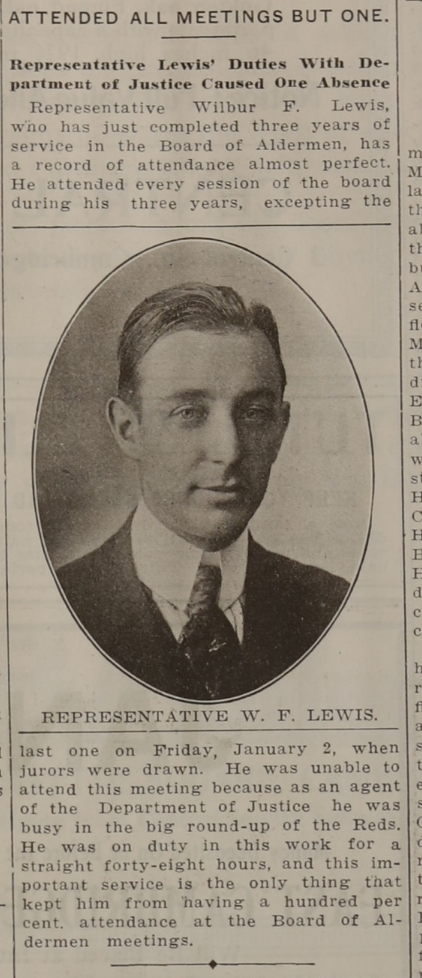
Among the clippings that I found recently through my research is a yellowed front page from the Somerville Journal, dated Friday, January 9, 1920. The headline reads “ATTENDED ALL MEETINGS BUT ONE,” and a portrait of my great-grandfather, Representative Wilbur F. Lewis, looking every inch the dutiful public servant.
After three years on Somerville’s Board of Aldermen, Wilbur had a nearly perfect attendance record. He had been present at every single session of the board across those three years with a single exception. And the reason for that one absence is what stopped me cold.
He missed the meeting of Friday, January 2, 1920, the paper explains, because “as an agent of the Department of Justice he was busy in the big round-up of the Reds.” He had been on duty in that work, it says, for “a straight forty-eight hours.” The Journal offers this as a point of pride — the one and only blemish on his attendance record, and a patriotic one at that.
It only took a quick Claude search to understand just how large the event behind that one casual sentence really was.
What “the big round-up of the Reds” actually was
My great-grandfather wasn’t moonlighting at some minor local affair. The date and the phrase “round-up of the Reds” point to one specific, infamous chapter of American history: the Palmer Raids.
To understand them, you have to feel the temperature of the country in those months. The First World War had just ended. The 1917 Russian Revolution had put a Bolshevik government in power and sent a tremor of fear through the Western world that revolution might be contagious. At home, 1919 had been a year of upheaval — major labor strikes (including the Boston Police Strike that fall, right next door to Somerville), race riots across the country in what became known as the “Red Summer,” and a wave of anarchist bombings, one of which damaged the home of the U.S. Attorney General himself, A. Mitchell Palmer.

Palmer, with the help of a young and ambitious Justice Department official named J. Edgar Hoover, organized a sweeping campaign to arrest suspected radicals, anarchists, communists, and especially foreign-born immigrants who could be deported without the bother of a full trial. The agency carrying out the work was the Bureau of Investigation, the direct ancestor of the FBI, which wouldn’t take that name until 1935. So when the newspaper calls Wilbur “an agent of the Department of Justice,” it is describing what we would now simply call an FBI agent.
The single largest sweep came on the very night Wilbur missed his aldermen’s meeting. On January 2, 1920, federal agents conducted coordinated raids in some thirty-three cities across more than twenty states, arresting thousands of people — estimates for that one day run from around three thousand to as high as six thousand — at meeting halls, social clubs, and private homes. Agents broke down doors and pulled people from their beds. The number of arrests vastly outran the number of warrants that had actually been issued.
And here is the detail that brings it home for a Massachusetts family: the Boston area was one of the storm centers of the whole operation. Of the thousands arrested nationwide, over eight hundred were from the greater Boston area. A later federal court record describes the New England sweep as between roughly eight hundred and twelve hundred people arrested across the region, several hundred of them afterward locked up on Deer Island, out in Boston Harbor.
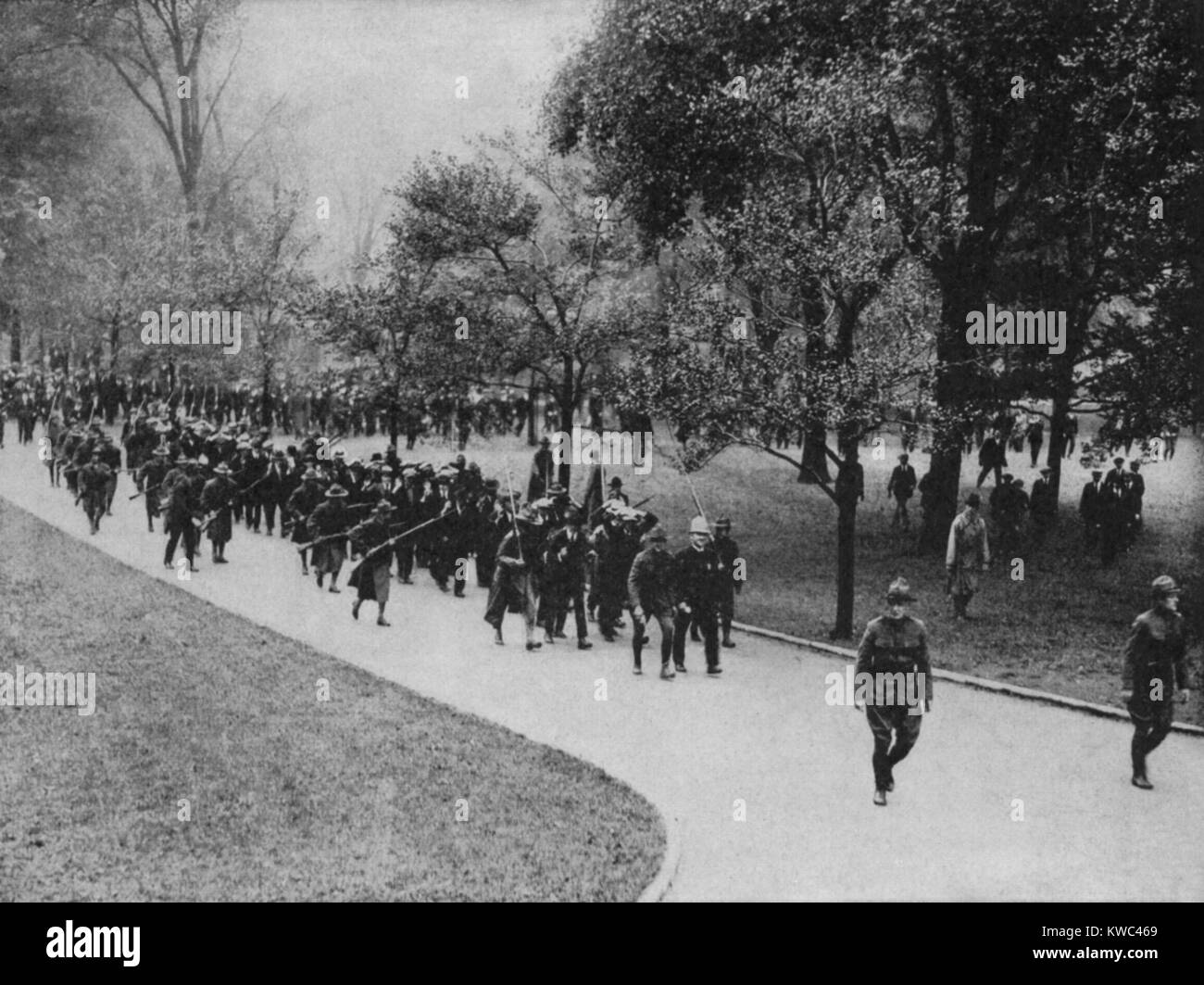
That is the work my great-grandfather was doing for forty-eight unbroken hours. As a Somerville-based Bureau agent, he would have been in the thick of the New England portion of the raids making arrests and processing detainees. These were simultaneous, overnight, all-hands operations, and the logistics of moving hundreds of arrested people were genuinely chaotic.
In January 1920, in the pages of the Somerville Journal, this was a badge of honor. The round-up was popular. It read as the young Bureau of Investigation taking decisive action against a frightening threat, and Wilbur’s part in it was something to celebrate.
How history changed its verdict
The cheering did not last.
Within months, the raids went from triumph to scandal, and it isn’t hard to see why. Most of the people swept up on January 2 had been seized without warrants. They were held in overcrowded facilities, frequently denied lawyers, denied contact with their families, and held for long stretches without being charged with any crime. Many turned out to have no meaningful connection to any radical organization at all — they had simply been in the wrong meeting hall, or the wrong social club, on the wrong night.
New England, where my great-grandfather worked, became the setting for one of the most important legal rebukes. In the Boston case Colyer v. Skeffington, federal judge George W. Anderson ordered detainees released and condemned the government’s conduct in scorching terms, writing that “a mob is a mob, whether made up of Government officials acting under instructions from the Department of Justice, or of criminals, loafers, and the vicious classes.” Among the lawyers who stepped in to argue against the deportations in that Boston courtroom were Harvard’s Zechariah Chafee and Felix Frankfurter — the latter a future justice of the United States Supreme Court.
The broader fallout reshaped American life. The outrage over the raids helped give birth to the American Civil Liberties Union. Officials within the government itself — notably Assistant Secretary of Labor Louis Post, who actually held the authority over deportations — reviewed the cases, found the evidence of dangerous subversion thin, and canceled the great majority of Palmer’s deportation orders. Of the thousands arrested, only a few hundred were ultimately deported. Even the FBI’s own published history today describes the raids as a low point, “a nightmare” of poor planning and trampled constitutional rights.
By the standards and convictions of his moment, my great-grandfather was doing his patriotic duty, and his neighbors honored him for it. That same duty also placed him inside one of the clearest civil-liberties failures in American history — a mass round-up, largely of immigrants, conducted without proper warrants and with little regard for due process.
A note from the present
The two sections above are family history and settled history. What follows is my present-day reflection.
I cannot write about my great-grandfather’s forty-eight hours without thinking about today’s headlines. The pattern that made the Palmer Raids infamous is depressingly ordinary. Take a moment of fear, point it at immigrants and dissenters, and let the federal government move faster than the Constitution can keep up. Warrantless arrests. People pulled from homes and meeting halls. Detention without charges, without lawyers, in overcrowded places. And, underneath it all, an attorney general and a Justice Department willing to treat the machinery of law enforcement as a political instrument.
We are watching it happen again.
The numbers alone are staggering. By early 2026, the number of people held in immigration detention reached the highest level ever recorded and reporting indicates the large majority of them have no criminal record at all, despite the official insistence that the targets are violent criminals. People have died in custody. Whistleblowers exposed an internal directive telling agents they could enter homes to make arrests without a judicial warrant — a directive that constitutional scholars and at least one federal judge say violates the Fourth Amendment, the very protection against unreasonable search and seizure that Colyer v. Skeffington was fought over a century ago. The administration tore up the longstanding policy that had kept enforcement away from schools, churches, and hospitals. Agents have staked out courthouses. In Minneapolis in January 2026, federal agents shot and killed two U.S. citizens.
The lesson of the Palmer Raids isn’t that the agents were monsters. My great-grandfather wasn’t a monster; he was a man doing what his government told him was right and necessary, in a climate engineered to make resistance feel unpatriotic. The damage was done not by villains but by ordinary public servants who let fear and authority do their thinking for them, and by leaders who were happy to supply both. The country needed the judges, the lawyers, the Louis Posts, and the ordinary citizens who said no — who insisted that a mob is a mob even when it wears a badge and carries federal orders.
Some of that pushback has already started, this time mostly from the courts — and, as it happens, from the same Massachusetts federal court that delivered Judge Anderson’s rebuke a century ago. Where it took an official like Louis Post to cancel the bulk of Palmer’s deportation orders, in February 2026 a federal judge in Massachusetts struck down the administration’s policy of deporting immigrants to third countries with no notice and no chance to object, ruling that it violated their right to due process. Within weeks an appeals court put that decision on hold while it weighs the government’s appeal, and the case looks likely to end up at the Supreme Court.
I oppose what is being done in my country’s name today. I oppose the round-ups, the warrantless raids, and the detention of people whose only offense is who they are and where they were born.
My great-grandfather’s generation eventually decided that the Palmer Raids were a stain. They didn’t reach that judgment in the heat of January 1920, when the parades were marching and the newspapers were proud. They reached it afterward, in the courts and the conscience of the country. I don’t want to wait for afterward this time.
Sources and further reading
On the Palmer Raids:
- FBI, “Palmer Raids” — the Bureau’s own account of its early misstep.
- HISTORY, “Palmer Raids” — the January 2, 1920 sweep and the 800-plus arrests in the Boston area.
- Colyer v. Skeffington, 265 F. 17 (D. Mass. 1920) — Judge George W. Anderson’s opinion, source of the “a mob is a mob” passage.
- Petition of Brooks, 5 F.2d 238 (1925) — a later federal opinion describing the New England arrests and the Deer Island detentions.
On the present-day parallels:
- HIAS, “The ICE Raids — What You Need to Know” — detention figures, deaths in custody, and due-process concerns.
- Council on Foreign Relations, “How Trump Is Reshaping Immigration Enforcement” — enforcement tactics and the Minneapolis shootings of two U.S. citizens.
- Center for American Progress, “ICE and CBP Have Become a Threat to Americans” — the whistleblower disclosure of the warrantless home-entry directive.
- CBS News, “Judge rules Trump ‘third-country’ deportation policy is unlawful” — Judge Brian Murphy’s February 2026 ruling.
- Migration Policy Institute, “U.S. Third-Country Deportation Agreements” — the appeal, the stay, and the road to the Supreme Court.